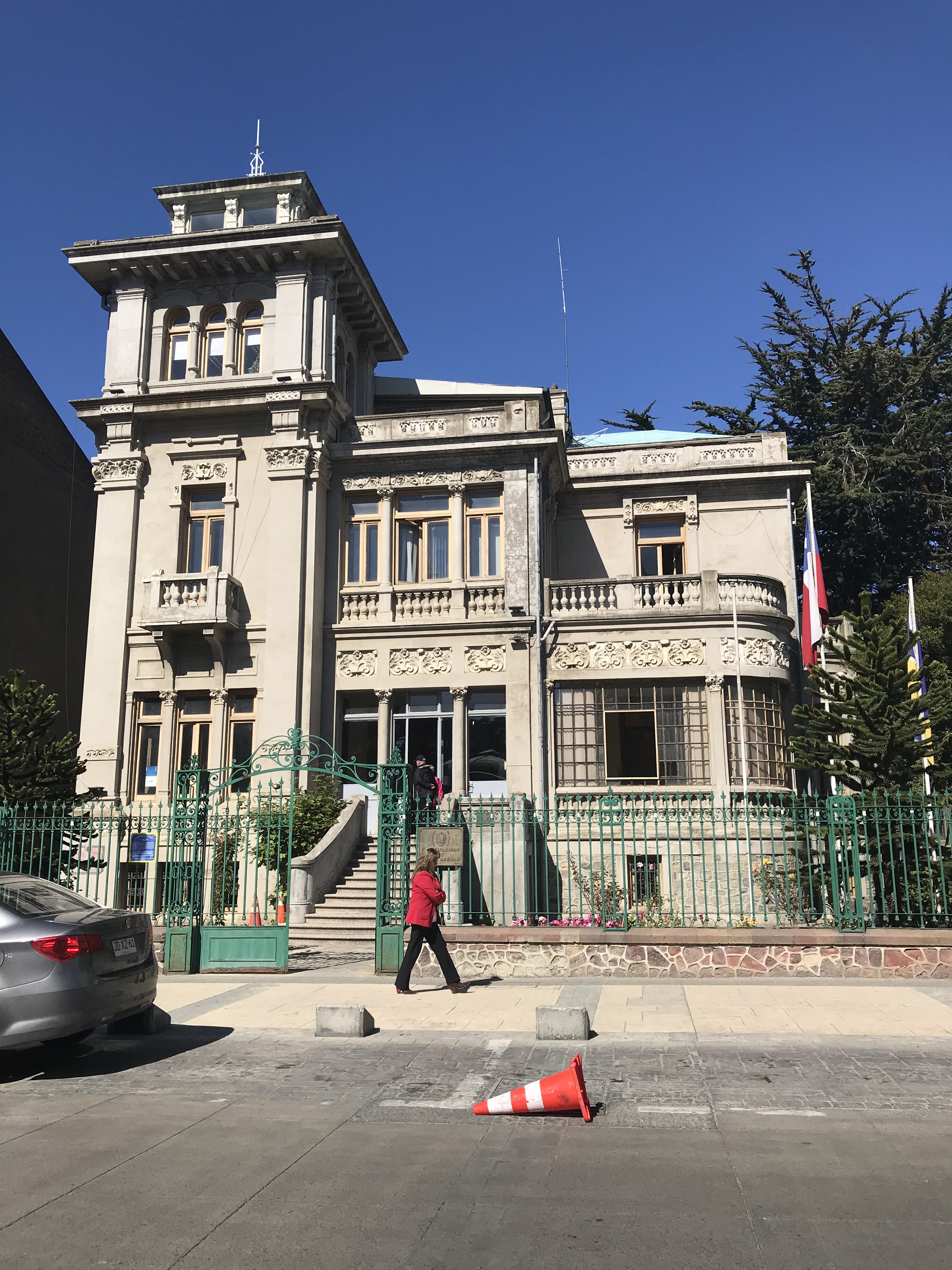
Building on the square 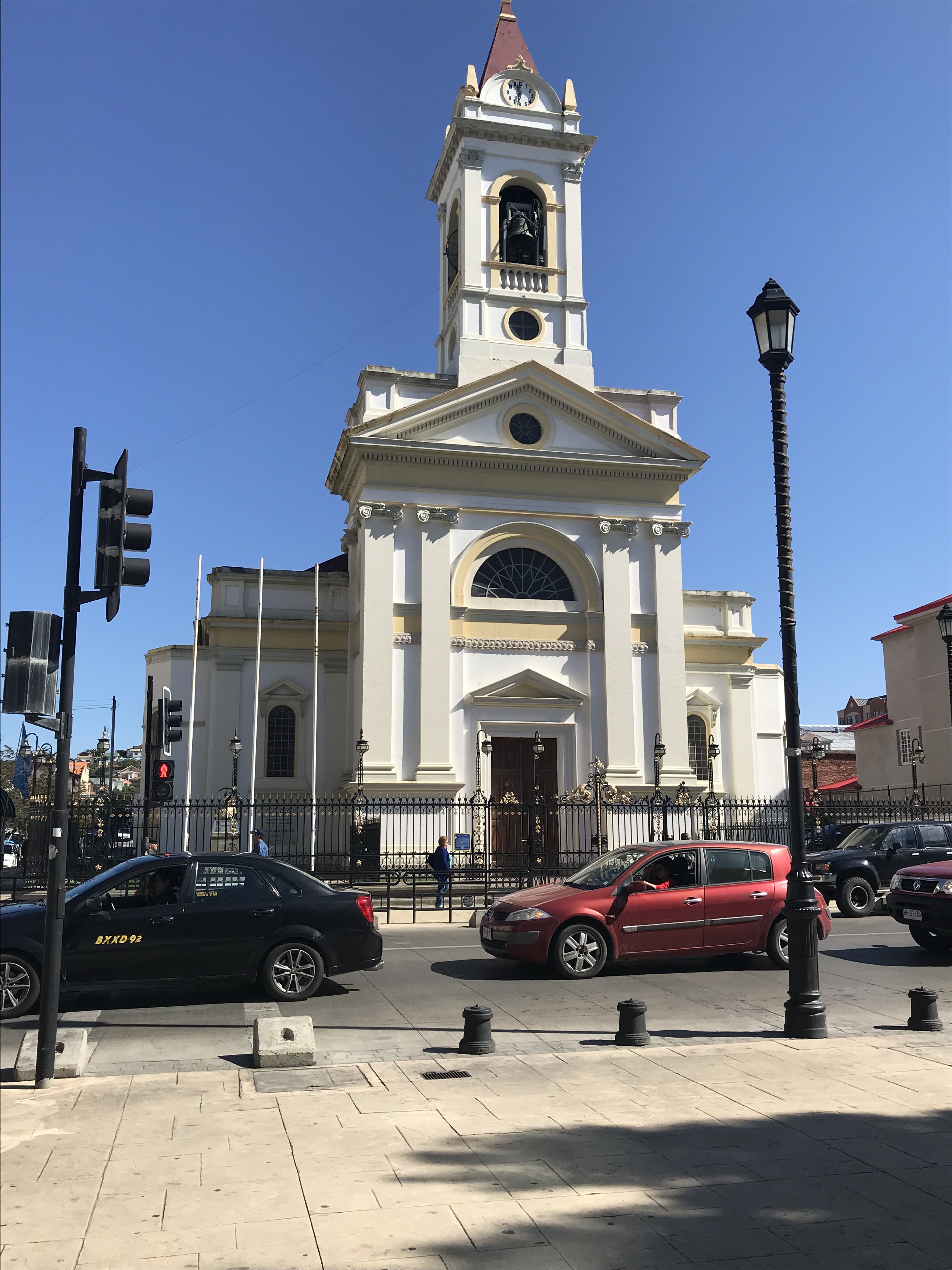
Church on the square 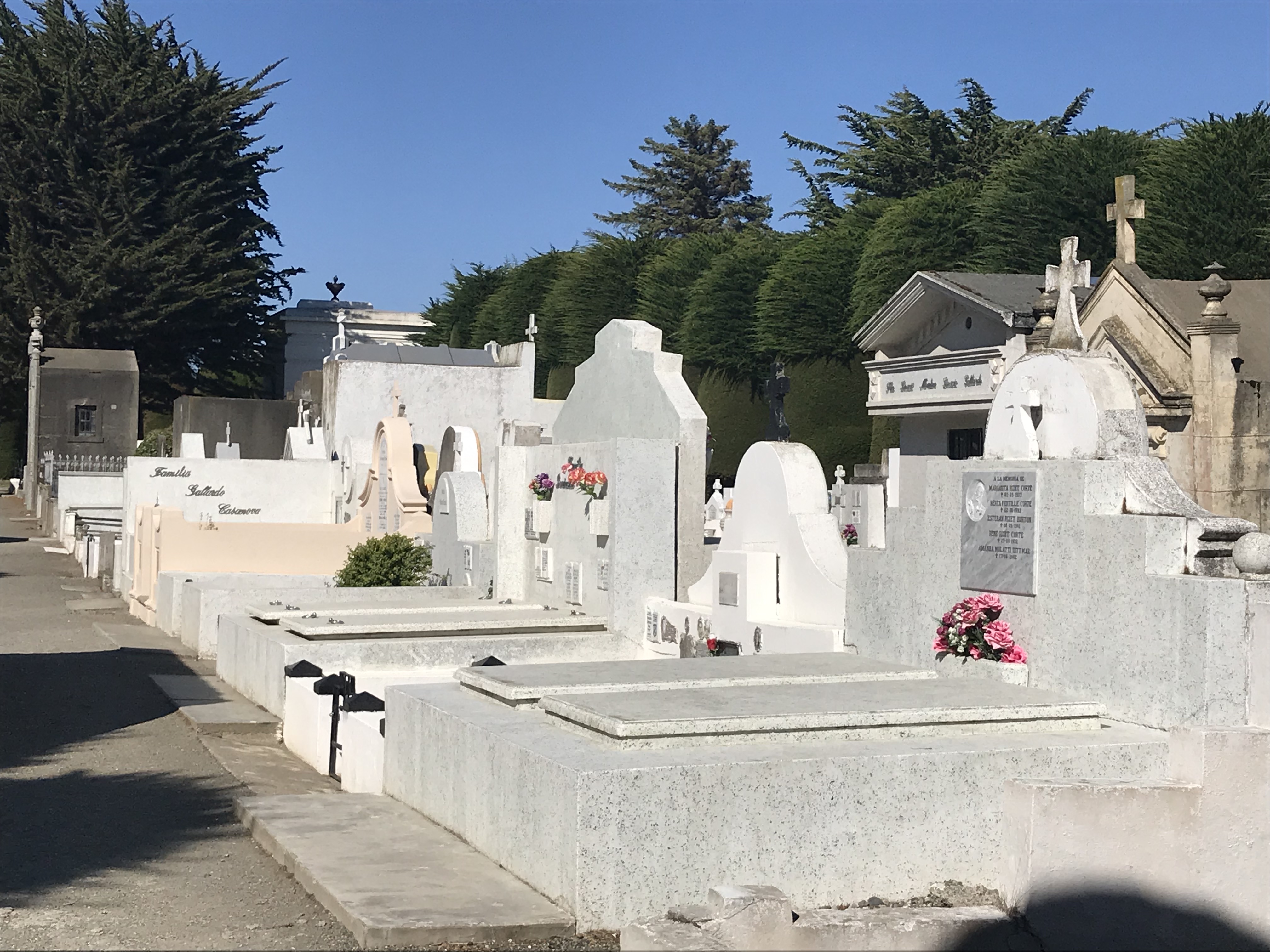
Cemetery 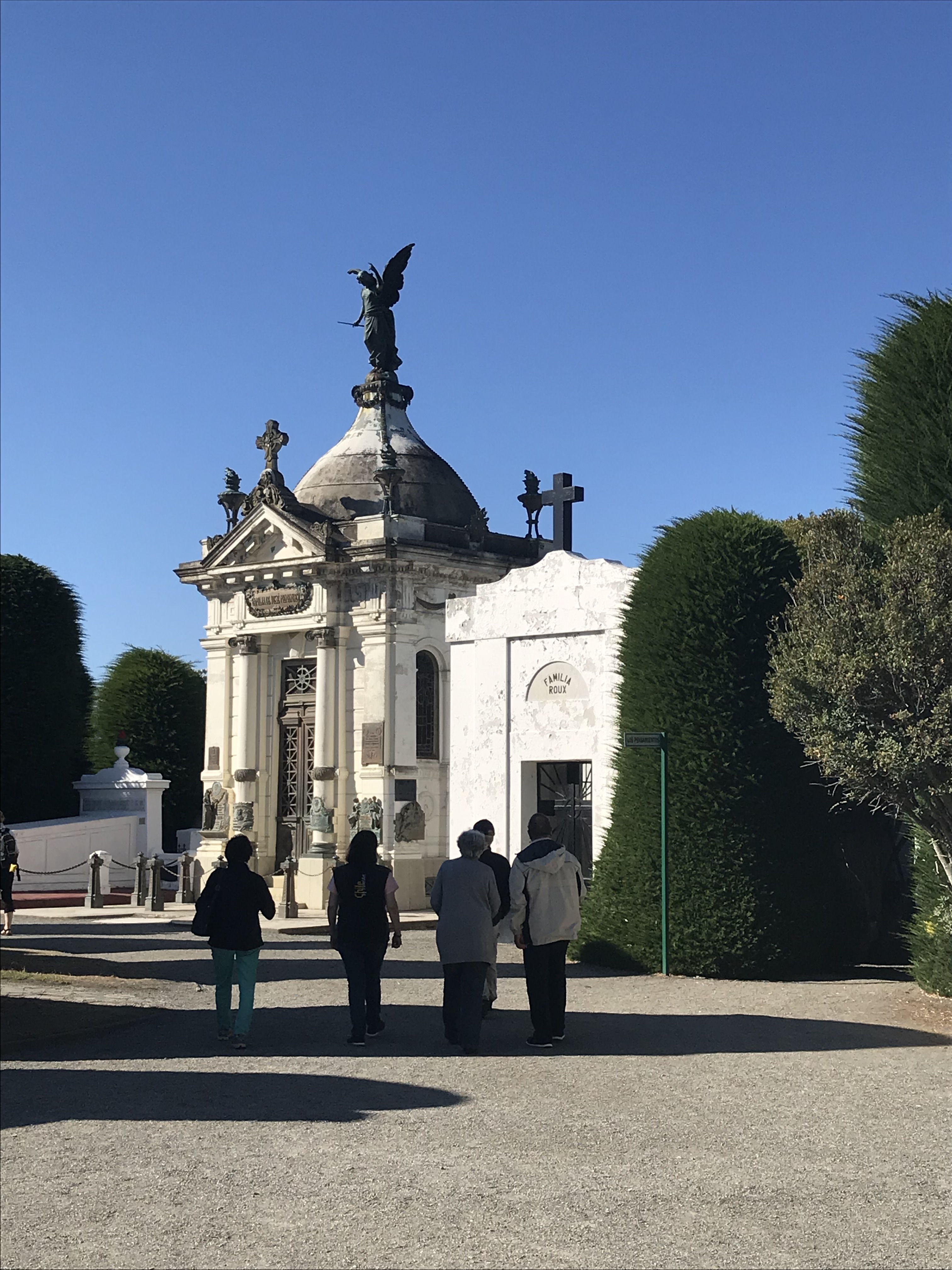
Cemetery 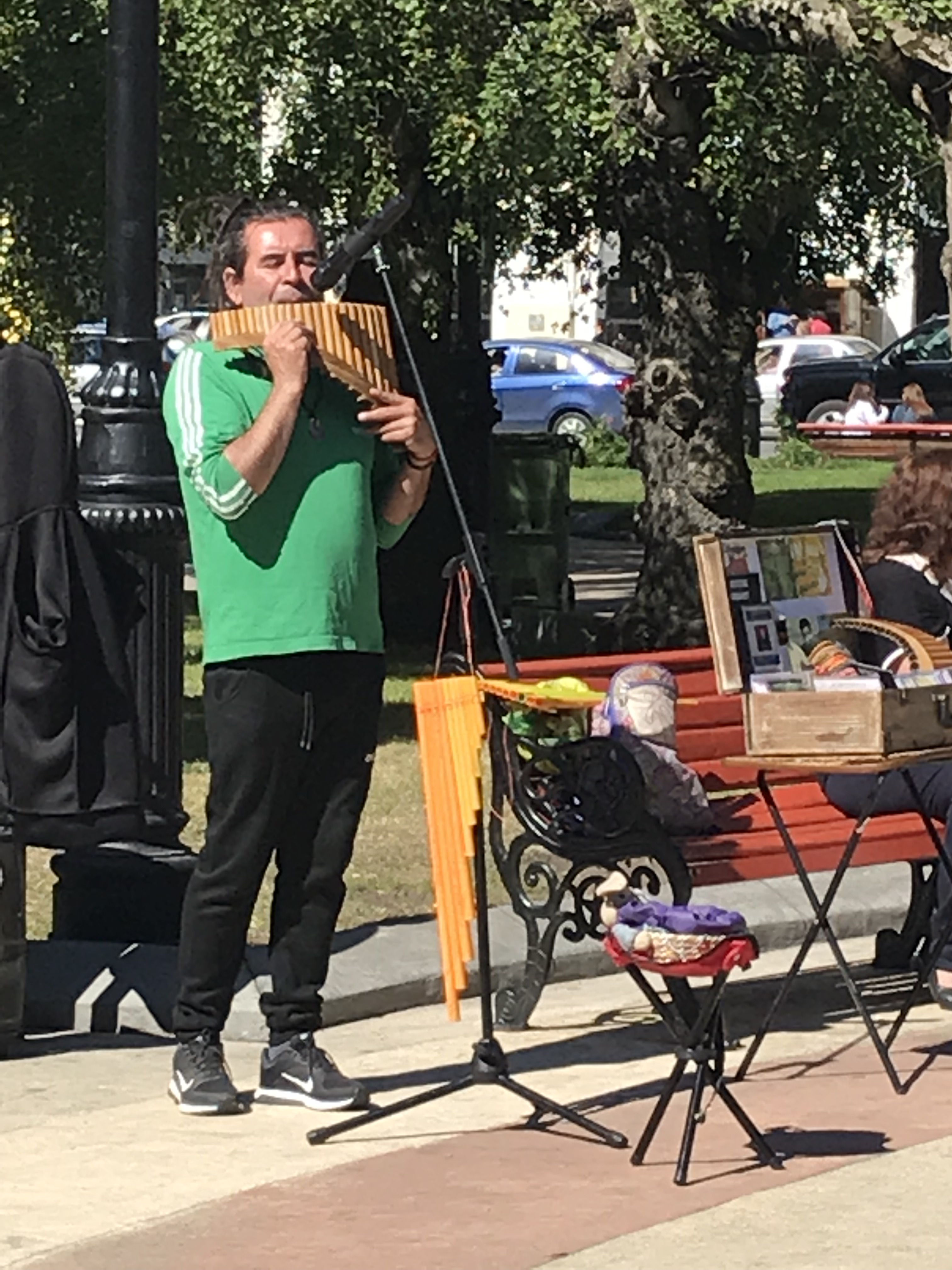
man in square playing the pan pipes 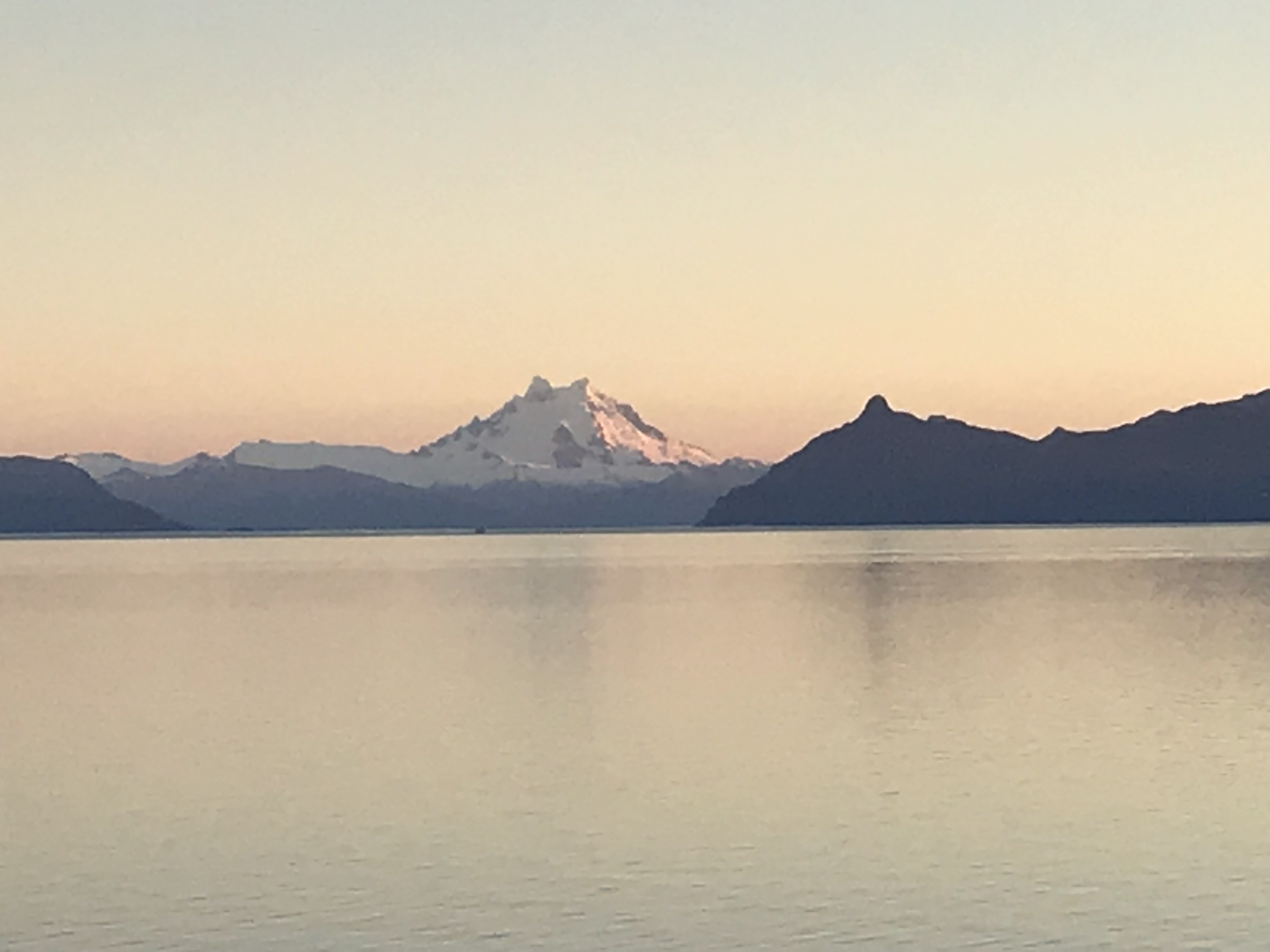
Mt. Sarmiento
We woke early (because in the midst of summer this far south sunrise is very early—and the days are very long).
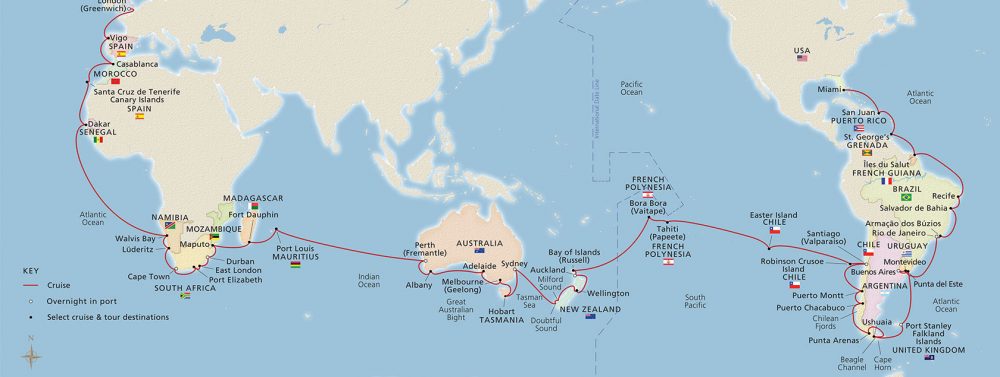
We are still in Patagonia which comprises the southern portion of South America and, thus contains significant parts of both Chile and Argentina. Chile gets the very bottom bit as it curves east under the bottom of Argentina. Inhabitants of Ushuaia and the rest of Argentine Tierra del Fuego can fly to Buenos Aires or other parts of Argentina, but in order to go by land they must enter Chile, cross a bridge from Tierra del Fuego to the mainland, and cross back into Argentina. They are really isolated by this because the Chilean-Argentinean border crossing requires a passport & visa.
Our guide for our morning bus tour of the area told us that today and yesterday were unusual—probably ‘best days of the summer,’ warmer, sunnier, and less windy than ‘normal.’ We could see Monte Sarmiento and other snow covered mountains far away across the channel, and that, we were told, happens only 2-3 days a year! So much for my conviction that, so close to Ushuaia, Punta Arenas has a much warmer climate.
Punta Arenas has a population of about 132,000 so approximately twice the size of Ushuaia. It looks more like a city in large part due to its patron Sarah Braun. Sarah was a Russian Jew who immigrated in 1874 and married Portuguese businessman José Nogueira, a pioneer of the sheep industry, which came to be Patagonia’s major source of wealth. He and Sarah commissioned an opulent palace in Punta Arenas by a French architect. When he died young, the wealthy widow completed the house and commissioned many other European style buildings in her adopted city especially around the central square. She also imported furnishings for her home and other buildings to make the area seem like a bit of transported Europe. The rest of the city is a contrast—rather furnishings ramshackle buildings ramshackle buildings (each house surrounded by a wall) with corrugated metal roofs—except for the sumptuous above ground cemetery reminiscent of that in Buenos Aires. In the square was a man playing the pan pipes; the song as we entered was Songs of Silence by Simon & Garfunkel.
Sailing away this evening it was still beautiful and in the high 60s and we were able to eat and then readon the deck until about 9 pm. We also saw several small dolphins leaping fully out of the water. Our resident whale watcher saw sei whales (a baleen whale—‘the third-largest rorqual after the blue whale and the fin whale’) but we only saw their spouting a few times. We are sailing south and east along the Magellan Strait and were excited to learn we will spend tomorrow sailing the Chilean fjords as well. –Cynthia
Keeping Up With The Rodriquez’s, Menendezes, Brauns, et al. One of the mandatory behaviors expected of a “Viking Traveler” in South Americais “debarking” the ship and going ashore. Ship-board shops are closed, no lectures and few other organized activities are scheduled, and there is no casino, so unless one wants to lie in the sun, go to the spa and/or exercise frenetically, there is very little else to do (except drink, I suppose!). While ashore, travelers bicycling or exploring without a guide are relatively free to go where they wish, but those of us “on tour” in buses or on foot dutifully go where we’re directed… and In each port we’ve visited recently, a minimum of 30 min is spent walking around a cemetery!
You’d think a graveyard would be the last place a savvy company like Viking would include on a tour comprised of elderly retirees. Why remind us of where we are all headed? It turns out that in those South American cemeteries we’ve visited, mausoleums are a major, if not the sole, feature. (Family members are interred within, we are told, many feet downwards, layered by generation.) And these houses of the dead are elaborate! While all have similar footprints and are constructed of similar stone, they are stylistically baroque, neo-classical, Italianate or Iberian and various mixtures of these, along with a potpourri of columns, statues of family and religious personages, and a variety of crosses, crucifixes, and plaques. With lots of photographs being taken by the touring traveler, the answer to the question raised above is these few acre are economical and historical microcosms of their locales, and visiting them is one way to see the city in depth (so to speak)!
One wonders where the servants, laborers, fishermen, and shops people are buried… not apparently with the upper middle classes. –Chris
 C&C travel the seas