In the
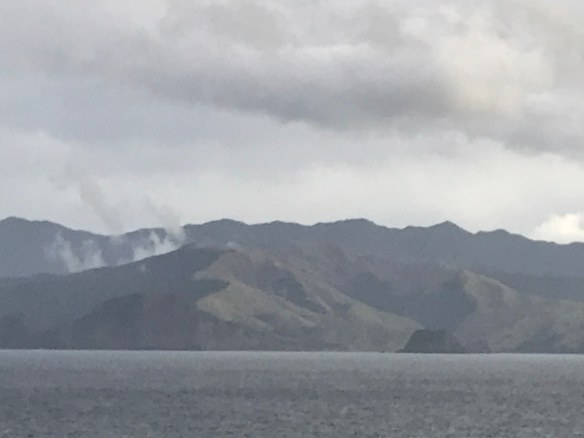
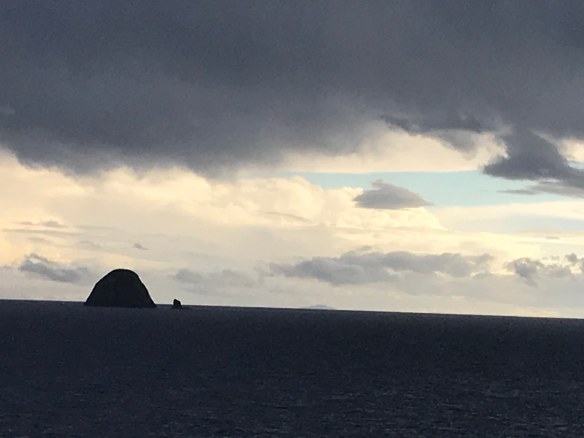
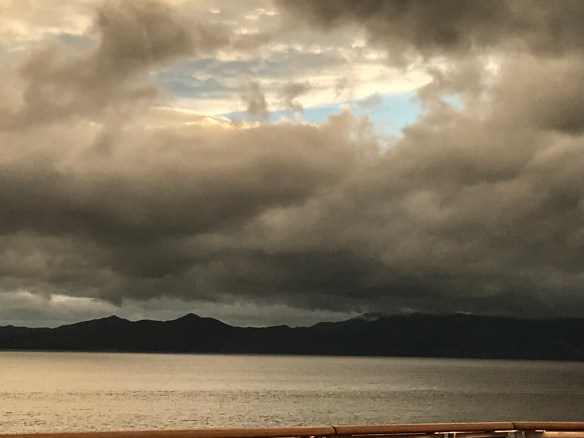
morning I was delighted to discover our route to Wellington took us close
enough to the coast to see land. On our
previous New Zealand cruise with Seaborn, except when entering and exiting a
port, our route was entirely out of sight of land. They said the shipping lane was seven miles
out—too far away to see. Apparently,
Viking sails closer to shore.
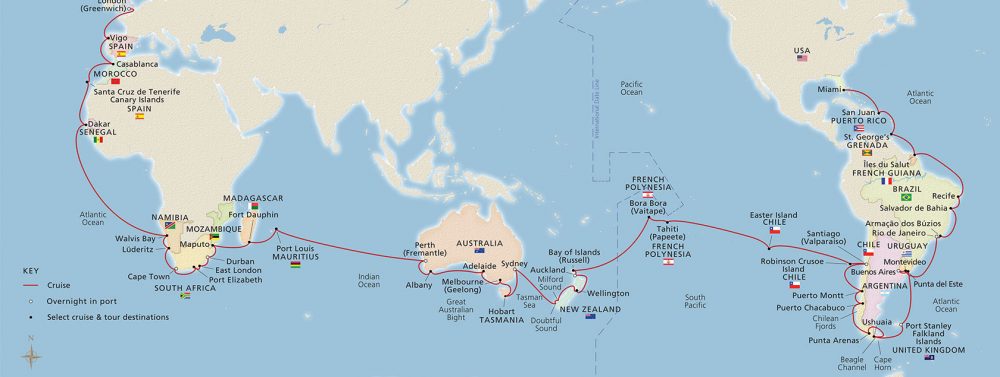
We are now half-way through our world cruise! We started our second tube of toothpaste (now we know how long a (6 oz) tube of toothpaste lasts) and are scheduled shortly for our second haircuts. How we measure time…
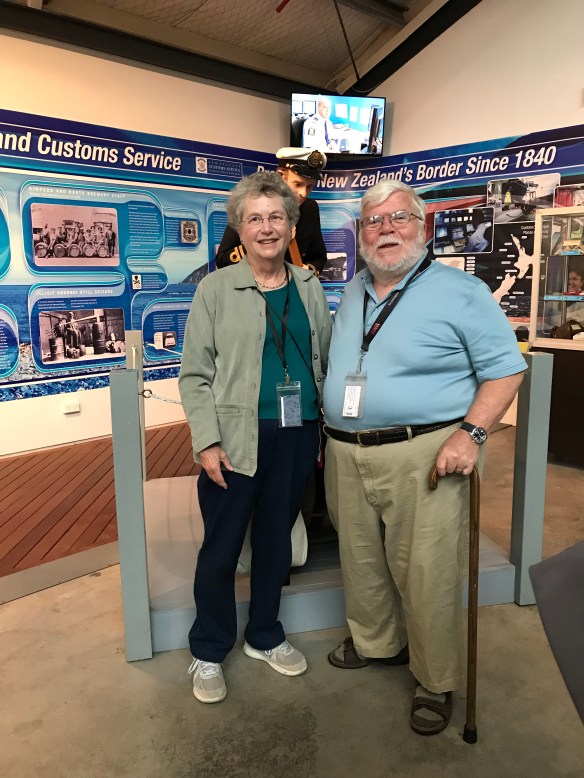
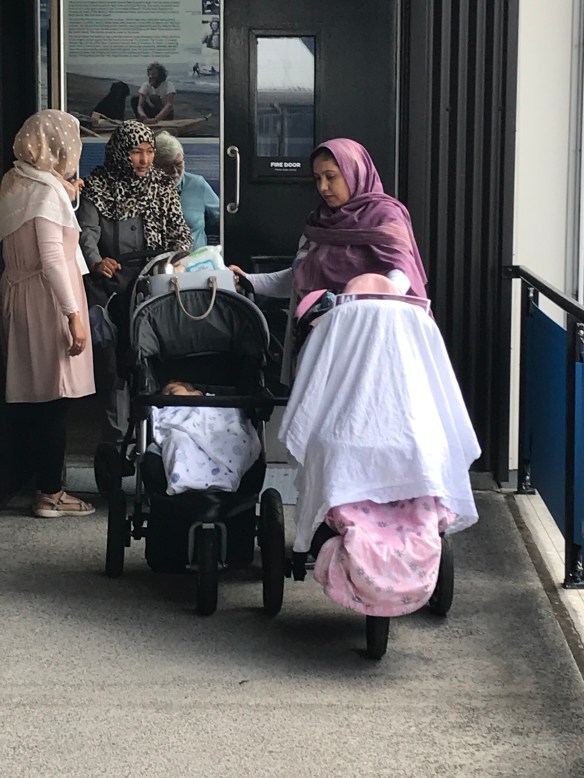
Other visitors to the Maritime Museum (they took the photo of us above)
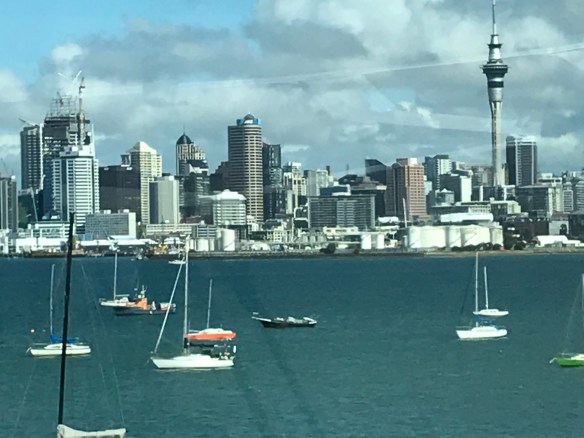
Auckland is known as the ‘city of sails,’ and they claim 1 in 3 inhabitants (1.5 million people) own a boat. (I suspect they don’t include children in their count of boat owners, but I don’t know for sure.) As with the Bay of Islands (whose population is much, much smaller), therefore, the bay is studded with impressive boats and a multiplicity of filled marinas. The one our guide was impressed by was an absolutely huge yacht said in port for maintenance; said to be owned by a very wealthy American (from Wyoming would you believe), it will require a crane to exit because it won’t fit under the rather high bridge!
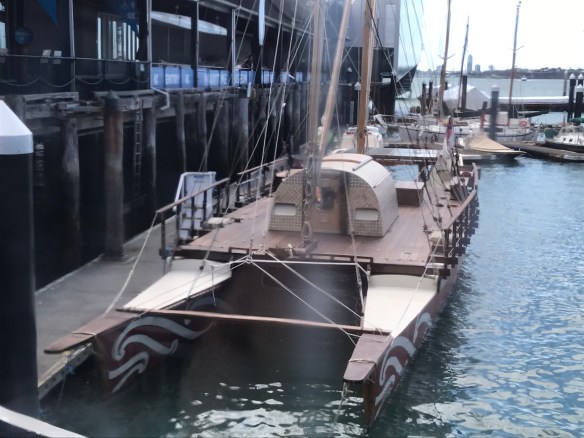
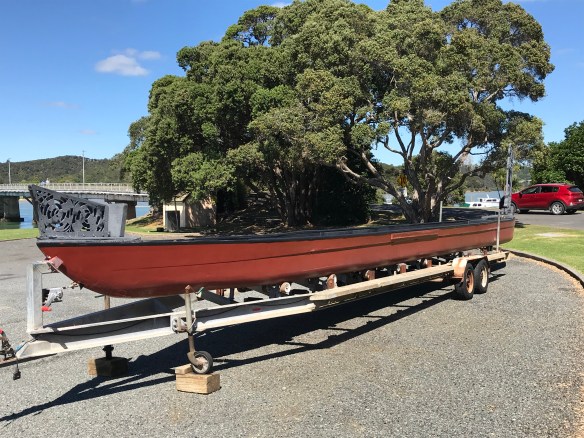
An overnight port, we docked in the center of town so we could walk to shops and other attractions. Our first tour, a panoramic bus tour didn’t leave until 4 pm, so we slept in (I don’t understand how we can sleep so much and yet be tired, since, of course, we’re working so hard!), had a late breakfast, and headed to the Auckland Maritime Museum a couple of blocks away. The museum was worthwhile and covered maritime history from the boats used by the Polynesians in the 13th century to reach New Zealand and become the Maoris to the 18th & 19th century British trading and settlers’ ships to modern-day Americas Cup boats.
That the Polynesians could have sailed so many thousand miles in their primitive craft and have such awareness of currents and navigation never ceases to amaze me. But the Americas Cup vessel amazed me also. The boat itself above the water weighs 1.5 tons and that’s only 20% of the vessel’s weight! The remaining 80% is in a deep stem with a large bulb at the bottom. The plaque explained that the boat on display was real, but the bulb was a substitute since the actual bulb would be too heavy to transport to or display in the museum! New Zealand has a proud history n the America’s cup and Auckland will again be hosting the race in 2020 so much excited building of much needed new housing is occurring.
After
the museum we had our first meal that we actually paid for! We went to a nearby restaurant right on the
harbor and had the freshest fish in fish and chips I’ve ever tasted.
In the
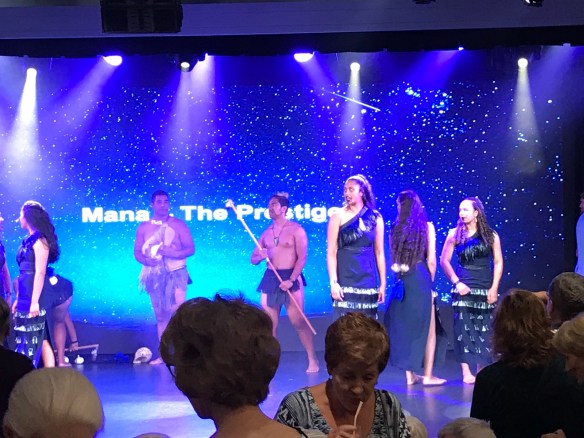
evening a local Maori dance group gave a performance on the ship. Beautiful dancing, and they did the
traditional Maori war haka with the wide open eyes, stuck out tongue, and
threatening gestures that we’ve seen in televised rugby games with the New
Zealand All Black team.
The Maori arrived in the late 13th century, the British in the last half of the 17th century so the Maori are not indigenous the way the Australian Aborigines, who arrived 50,000 years ago (more or less…) are. Relations between the British and Maori were generally amicable it is said, with various times of unrest and disagreements. The several tribes of Maori also warred with each other. In 1840 the Treaty of Waitangi (where we were yesterday) was signed—multiple copies each in a different language (English and various Maori languages)–by the English representative and five Maori chiefs—the earliest treaty between a western nation and the place they colonized. This is, we’re told, due, at least in part, to New Zealand being colonized so late. By that time the British had some experience in colonizing places and some understanding of what didn’t work. They concluded that it was better to encourage mutual respect and peaceful co-existence. Of course, the treaty wasn’t really honored until over 100 years later but then (in the 1970s I believe) it did form a basis for establishing a multi-cultural government. There are still disagreements over land as it seems the various copies didn’t all say exactly the same thing… But at the present time they seem to have reached some form of (possibly grudging) respect and commitment to a united, multi-cultural nation.
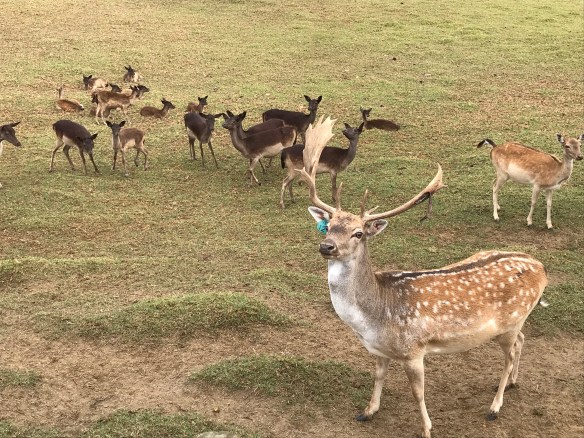
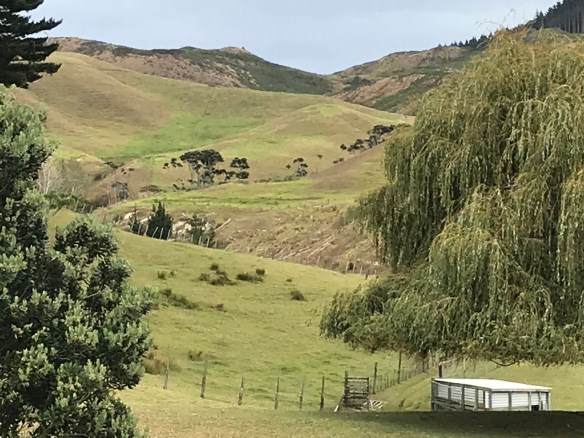
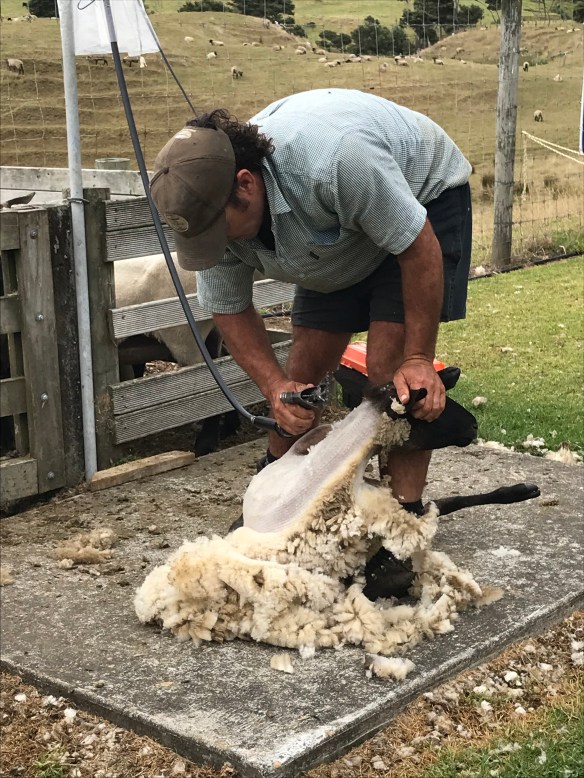
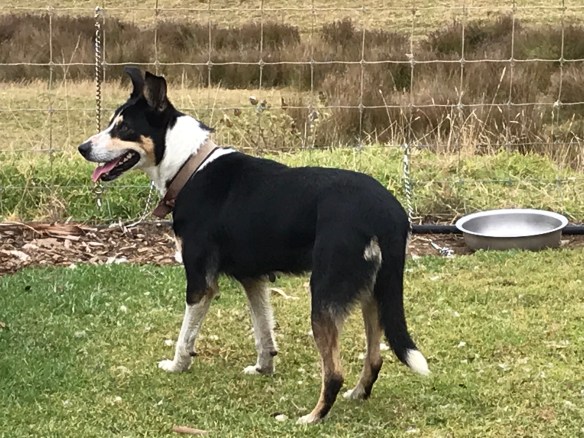
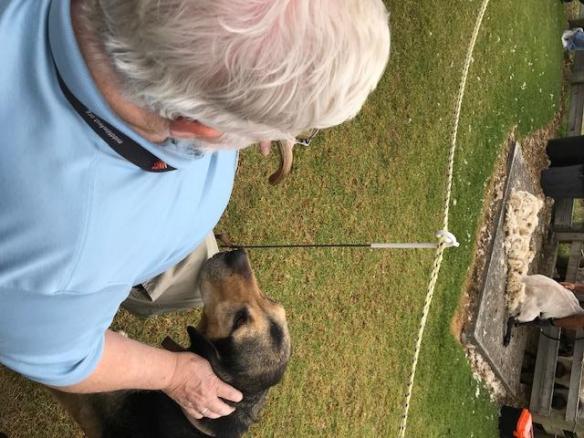
The second day we took a bus to a farm in western New Zealand where they demonstrated sheep shearing and sheep dogs maneuvering the sheep. One aspect I’d never seen before was that in addition to two border collies doing the herding, there was another non-border collie designated ‘the barker’ who barked and got the sheep out of the pen. They did quite an impressive job, and ‘the barker’ was getting on in years (his handler said he’d been retiring himself for about a year now). Since he loved to be petted, he and Chris became fast friends. The scenery was lovely, the farmhouse modern and beautiful (bedroom with full windows on three sides), the setting idyllic, and the people friendly and engaging. Besides they fed us tea, coffee, sandwiches, and cakes—always enough to make me happy! They had quite nice vegetable and flower gardens as well as a hot tub and small (4 or 5 holes) golf course, and deer. Just as we finished, the heavens, with little warning, opened up and soaked us.
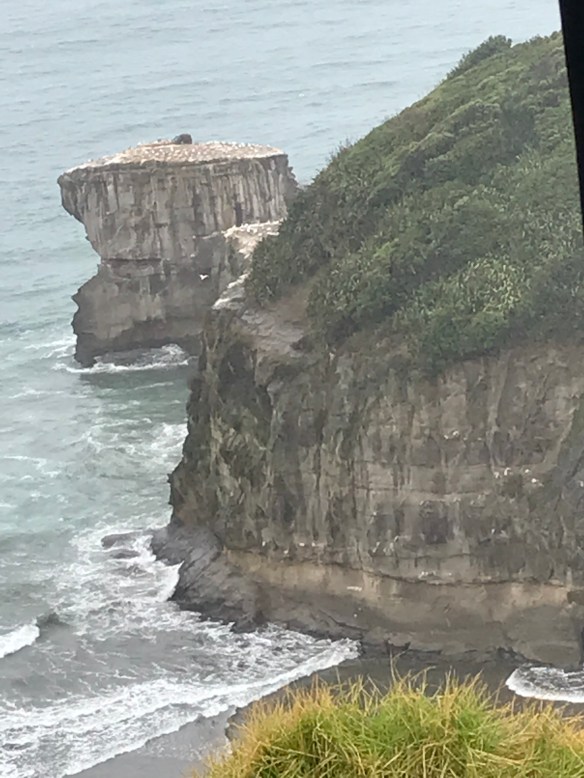
From the farm we travelled to the west coast to view a gannet colony. Since it was still raining hard, I contented myself with photographing long distance from the view point, but others actually walked out to the colony, and one man showed me a photo he took of a baby gannet close enough to touch (but he didn’t…)
Sailing out was again lovely and seemed later that mid-afternoon due to the dark clouds.
We
moored in the harbor of this beautiful, island studded bay (our guide says 144
islands—or 145 today including our ship, which is as big as some of the
islands) filled with many beautiful boats, and we tendered ashore. A bus tour showed us the countryside is
beautiful as well—hills (some quite large), valleys, streams, waterfalls, and
towns. The Bay of Islands is close to
the northeast end of New Zealand and, thus, has a semi-tropical climate with
little seasonal temperature variation but seems to be somewhere in the high 60s
to low 80s year round.
Then we
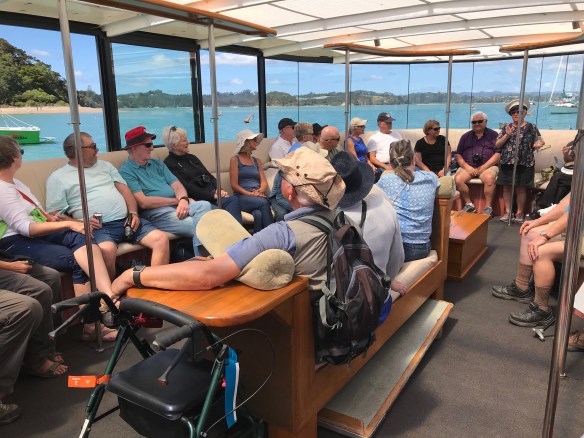
had a ‘lunch cruise’ in the bay—it turned out to be less of a tour than a
floating lunch with, unfortunately, a captain who told bad jokes and added
parlor games. However, we did spend a
hour off the boat in Russell, the site of the first European settlement, and
across the bay from Waitangi. Despite
its colorful history and bad reputation as lawless and full of prostitution, it
is now a charming village and popular tourist destination.
The
timing of the lunch cruise meant we were on the last tender before the ship
sailed, and we waited for a group of stragglers who’d missed the last shuttle
from town to pier. Fortunately for them,
the shuttle bus driver passed on his way home, saw them, and picked them up and
shuttled them back to the pier.
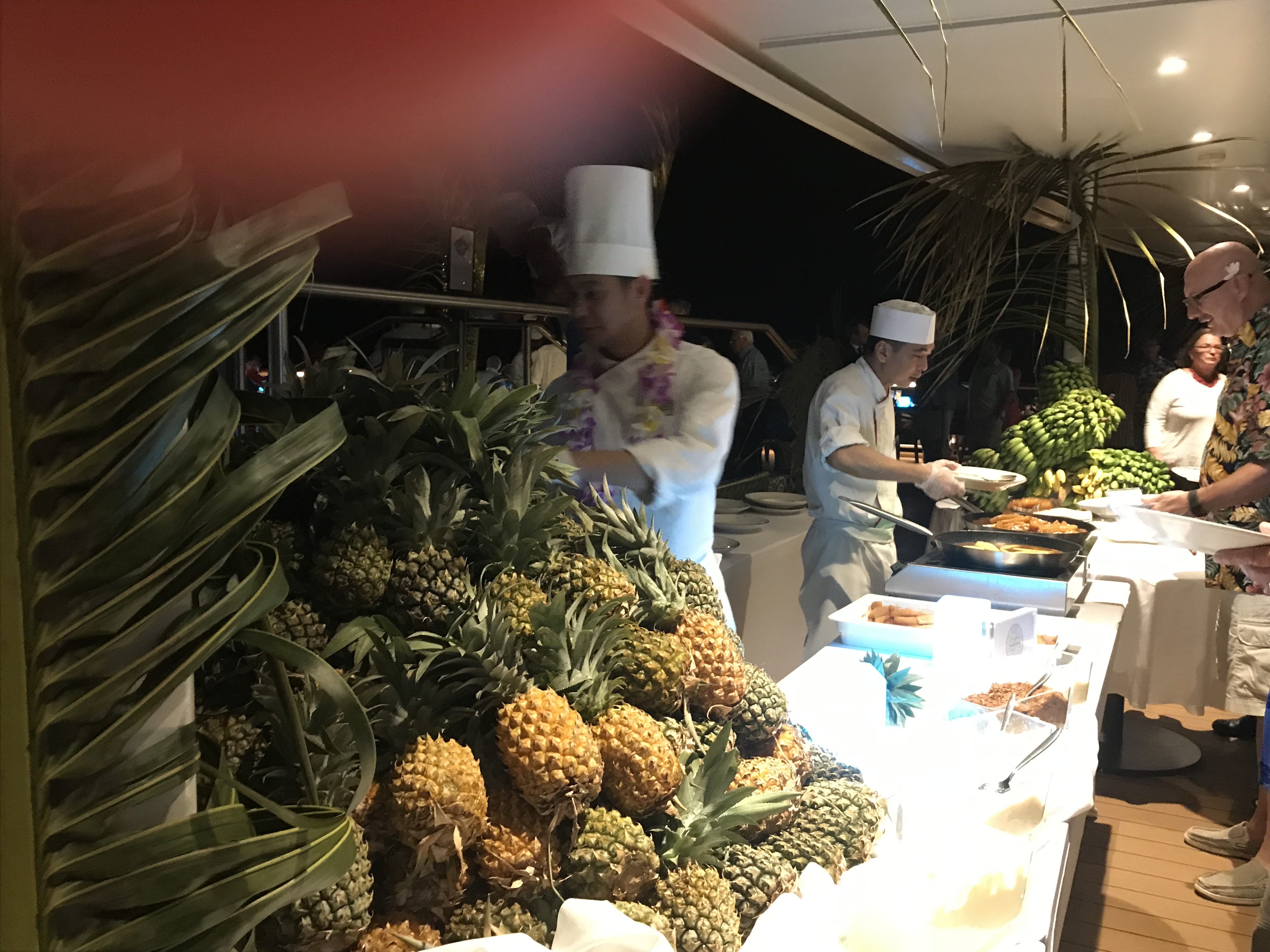
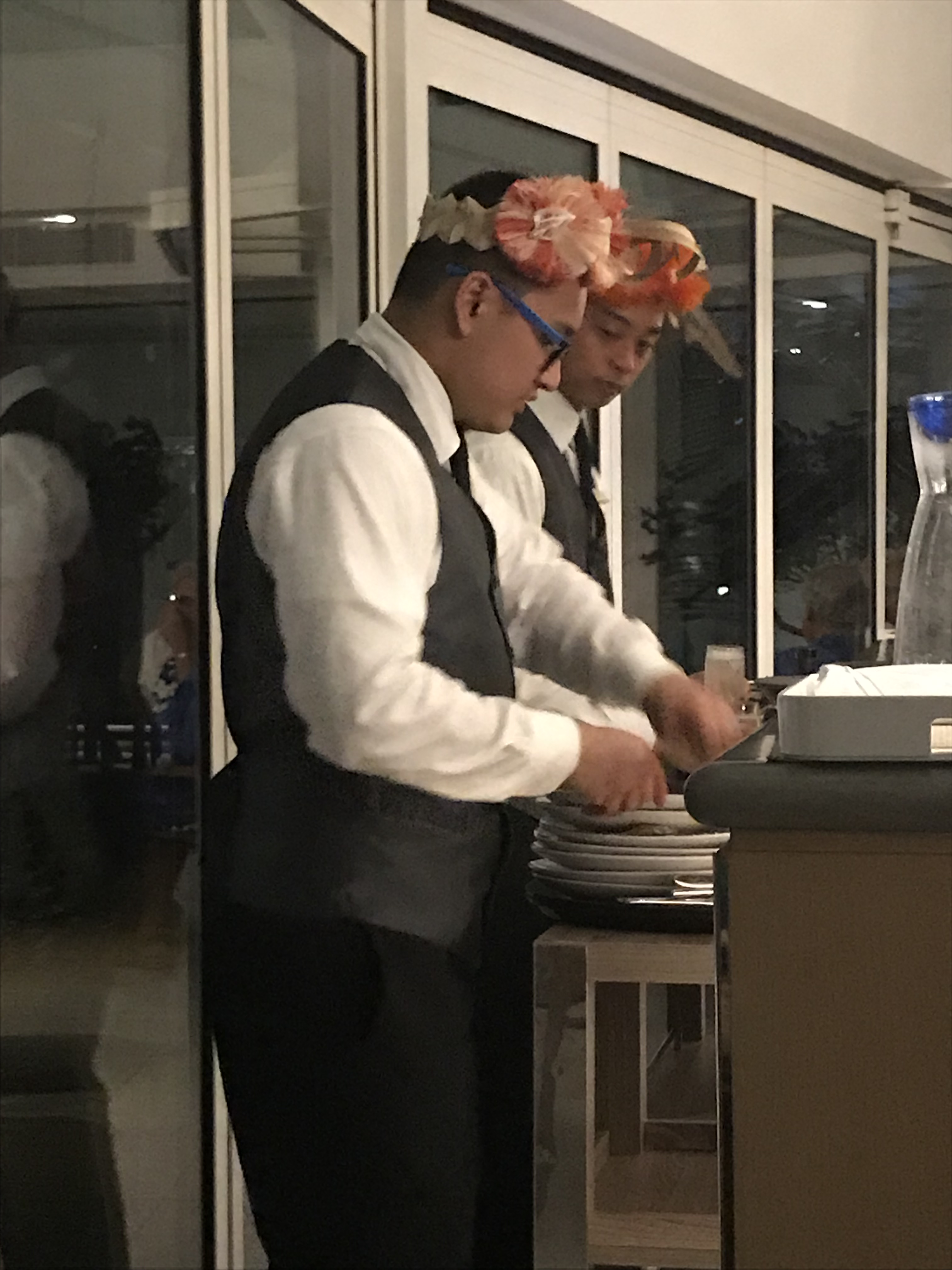
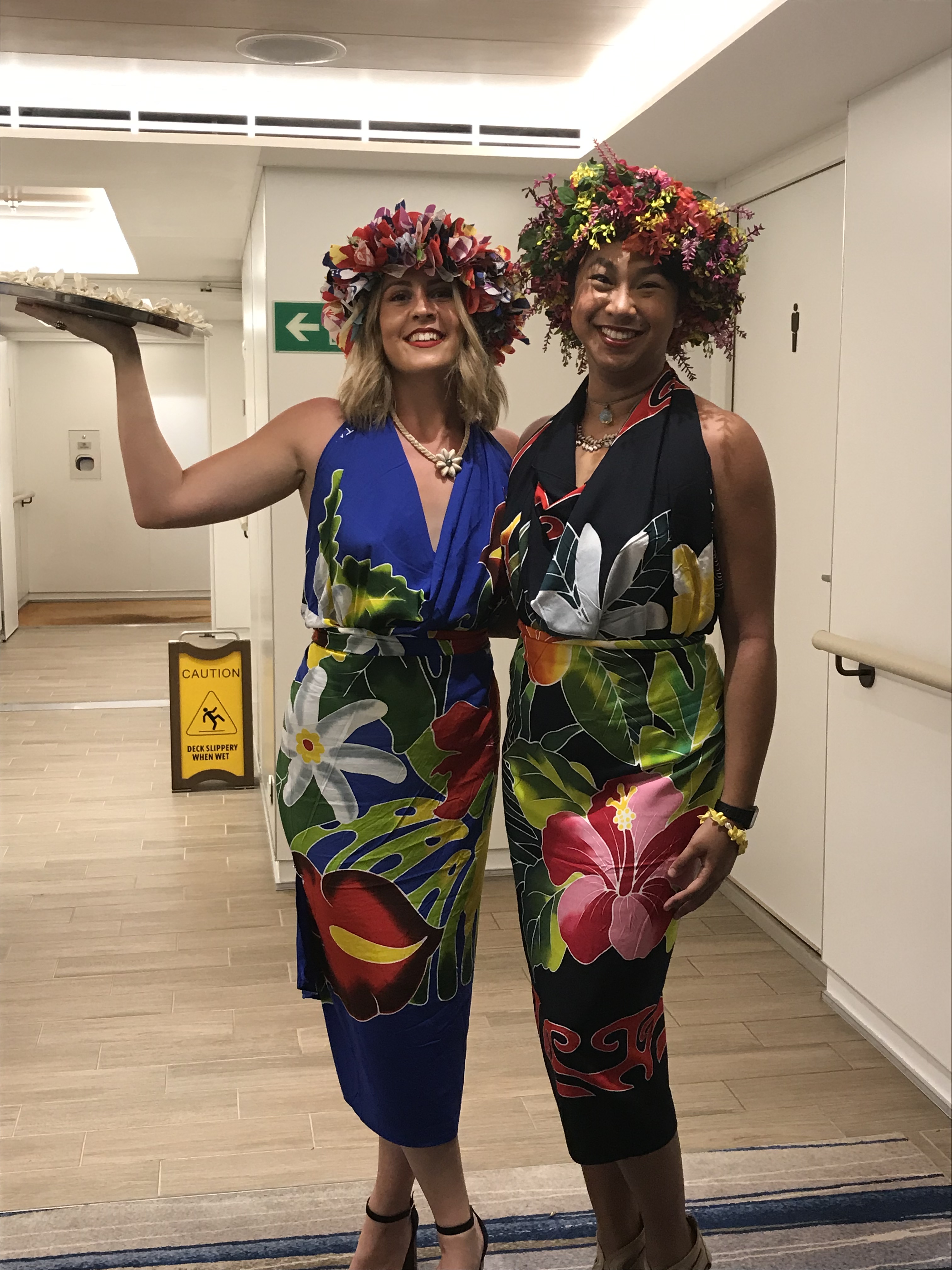
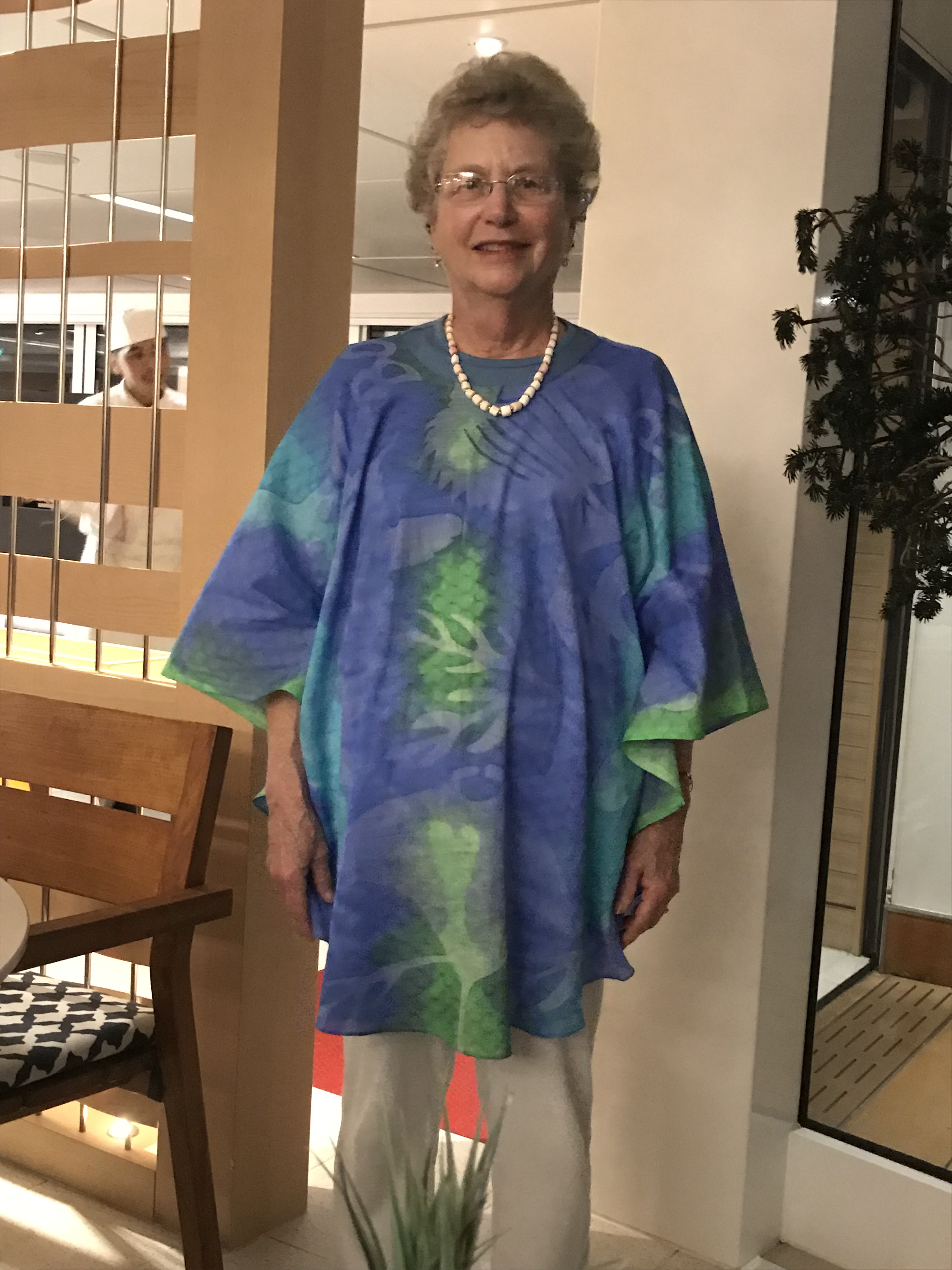
Polynesian night. Our first night out from French Polynesia we celebrated with a feast prepared in part from all the food Chef purchased at their markets. It included monkfish, lobster, superb filet mignon (I’m told the fish and lobster were also superb), stuffed sweet potatoes (delicious), and incredibly good pineapple sautéed in—probably–brown sugar, and other dishes too numerous to mention (or, unfortunately, to sample). We were all encouraged to acquire and wear Polynesian attire, and the staff did as well—even if only silly flower headgear in some cases. I wore a new Polynesian top but couldn’t compete with our lovely singers in their pareas.
International Dateline. Although I often find it difficult myself to calculate days when they span two months, I can tell you that, in our cruise itinerary and on the calendar, February 28-March 5 is 6 days. But, not so fast… we only have 5 days. Saturday, March 2 is imaginary; it disappeared when we crossed the international dateline. One night it was Friday and the next morning Sunday. Apparently we pay for all those extra hours of sleep by losing 24 hours in one fell swoop (and then continue to gain it back between now and returning to Vermont.)
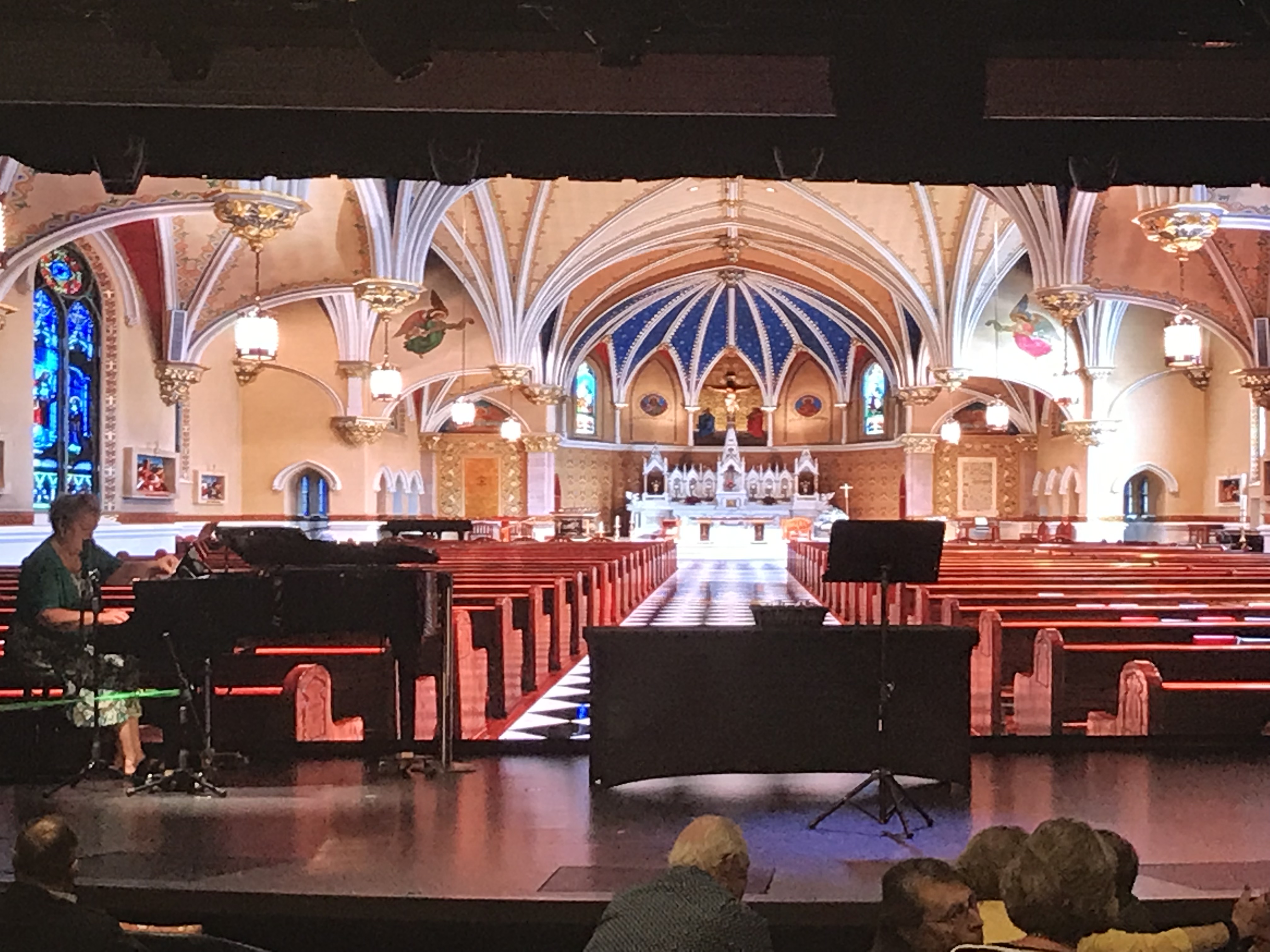
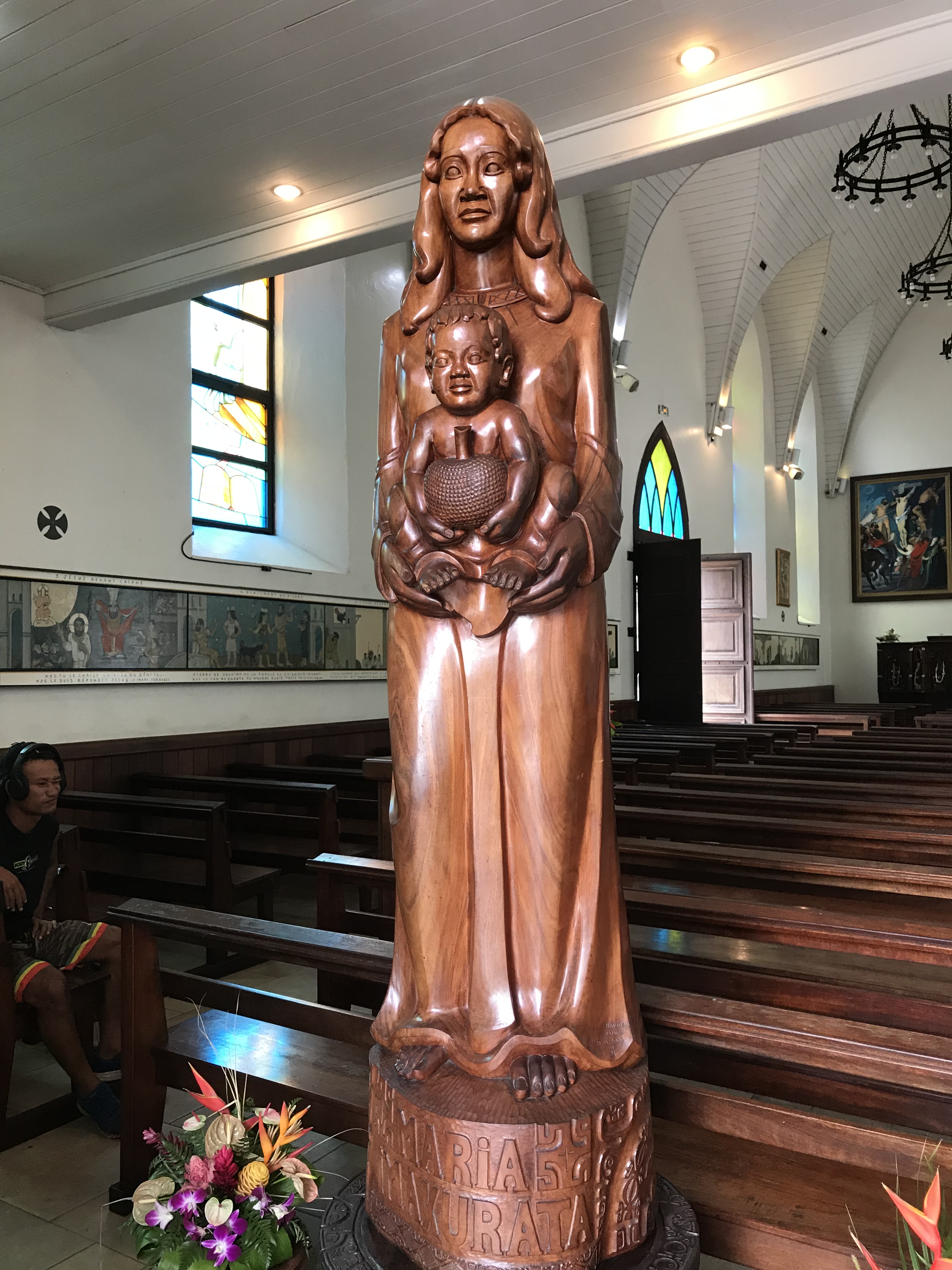
Our church for today, a French Polynesian cathedral
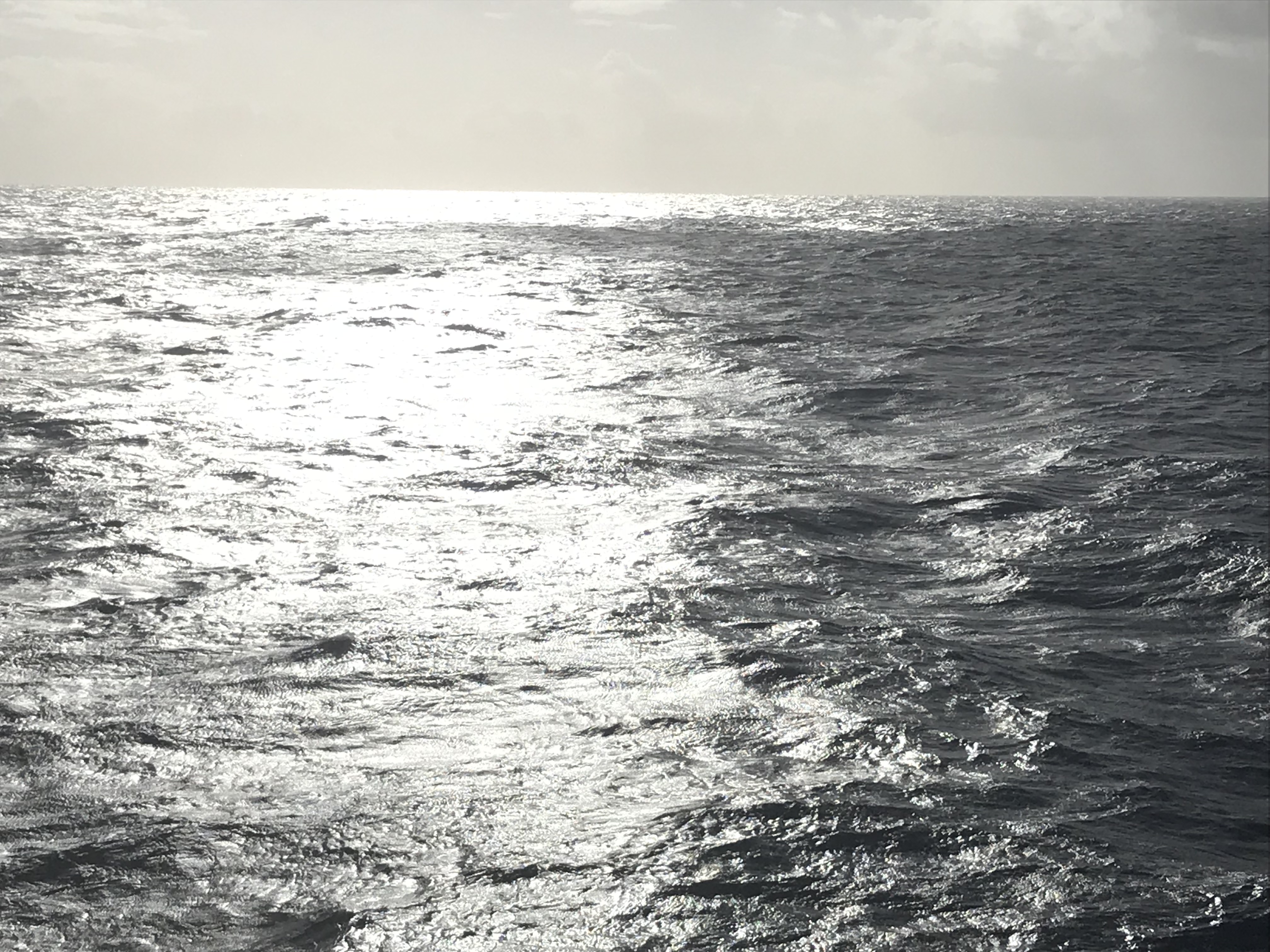
The sea later in the day when the sun came out
Sunday. We’ve had ‘rough’ seas a few days and the entire cruise is one long balance exercise, but Sunday morning arrived with a vengeance. I think I heard the Captain mention ‘gale force ten.’ Spray came up over the windows when we were breakfasting near the bow on deck 7 (and deck A, the deck below deck 1 is also above the water line) and actual waves came to the top of the windows on deck 1 where we had bridge class (and which the teacher taught seated for the first time.) They locked the doors to the outside decks, including, I believe, our balconies so I couldn’t even get photos of the waves. Certainly this was not the ‘pacific’ Pacific! My theory is that the sea is angry we dispensed with March 2.
Between breakfast and bridge class we attended the Sunday service. Being the first Sunday of the month this was communion (takes me back to my childhood when that was the case in the Episcopal Church as well), but Heather, our service leader (and cruise director), said it wouldn’t be a good idea to serve red wine (in real wine glasses) in this weather so we’d postpone communion until next Sunday. She also asked us to remain seated during prayers and even hymns—while she stood unsupported on stage in her trademark 4-inch heels. I guess she has more practice riding the waves than we. At least, I think we can conclude we don’t get seasick—the rocking and rolling didn’t even affect our appetites at all.
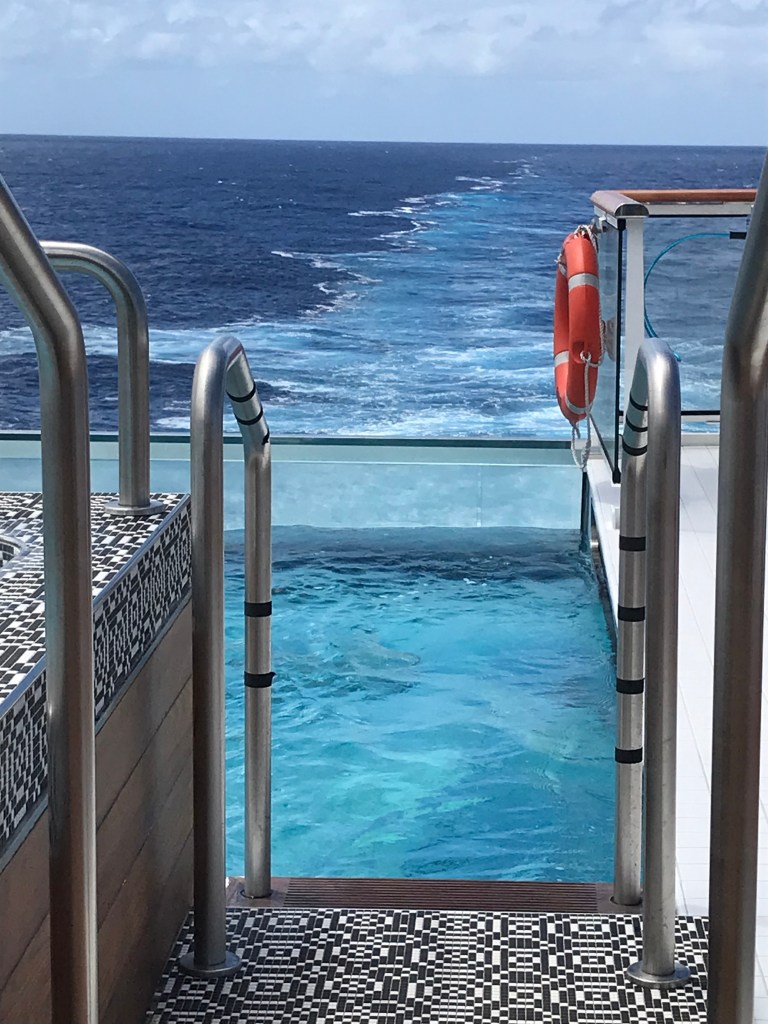
The aquamarine wake over the aquamarine pool
The pacific Pacific
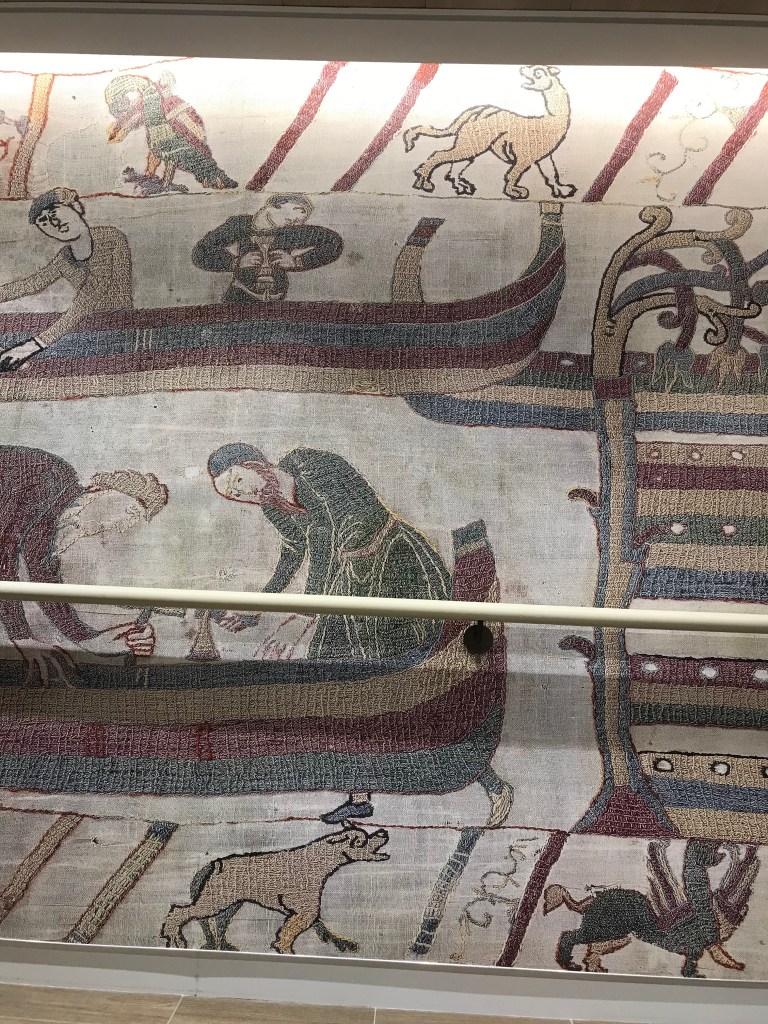
Bayeux tapestry scene in the stairway landing
Monday & Tuesday. We were happy to awake Monday to a more moderate, though still somewhat rough sea, and Tuesday the ocean was back to ‘pacific’ and I could walk the course around the outside deck.
Netherly Fuller, an anthropologist and archaeologist on board with her husband the ‘resident historian’, did a workshop titled “Recreate a Bayeux tapestry animal.” She’d brought photos, fabric with outlines, yarn and other necessities and showed us how to do the stitches. I loved it and am hoping to finish the lion I started and perhaps even do another one before the trip is over. The Bayeux tapestry is big with Viking and the wallpaper in the stairways is even greatly enlarged reproductions of scenes from the tapestry. –Cynthia
Rough Seas and Pacific Swells. During the night we lost March 2nd as Viking Sun crossed the
International Date Line and for a double whammy, encountered rain, high winds
and turbulent seas as he ship entered a tropical depression.
(The Date Line is located mostly at 180
degrees or half-way around the world from the prime meridian that passes
through Greenwich, England. “Mostly”
because of politically corrected deviations, for example, in Polynesia that allow
American Samoa and nearby Tonga to observe the same time on different days. A similar deviation separates Siberia from
Alaska and the Aleutian Islands. We
will, of course, regain much of the lost day as we cruise westwards towards
London.)
Depressed,
the ship no longer rocked us gently while we slept; but rather interrupted our
slumber with its sideways jerks, plunging porpoise movements, and rumbles and
smacks as swells passed beneath our keel. By morning the rain passed but, if anything,
the turbulence increased. Pacific swells
that previously seemed subtle became markedly obvious: their peaks exhibited
wind-tossed caps and their trough, deep, shadowed depressions. At noontime the Captain told us during his
daily address, the swells were topping out at 12 to 15 ft above their troughs
and the wind was averaging 40 knots (with gusts to 60 knots)… and our speed
had overnight been drastically reduced from 16 to 6 knots. A day later much of the turbulence had
subsided but rolling swells were still evident from our elevated cabin on Deck
5. From windows in the Chef’s Table Restaurant on Deck 1, high swells were
still dramatically alternating with deep troughs, and waves occasionally
covered the restaurant windows.
Navigating the rocking deck challenged me,
although my walking was much easier when the ship was traveling across the
troughs or parallel to them. Fortunately,
Cynthia, staff, friends and strangers were always at hand to assist me as I
gyrated along the various passageways. —Chris
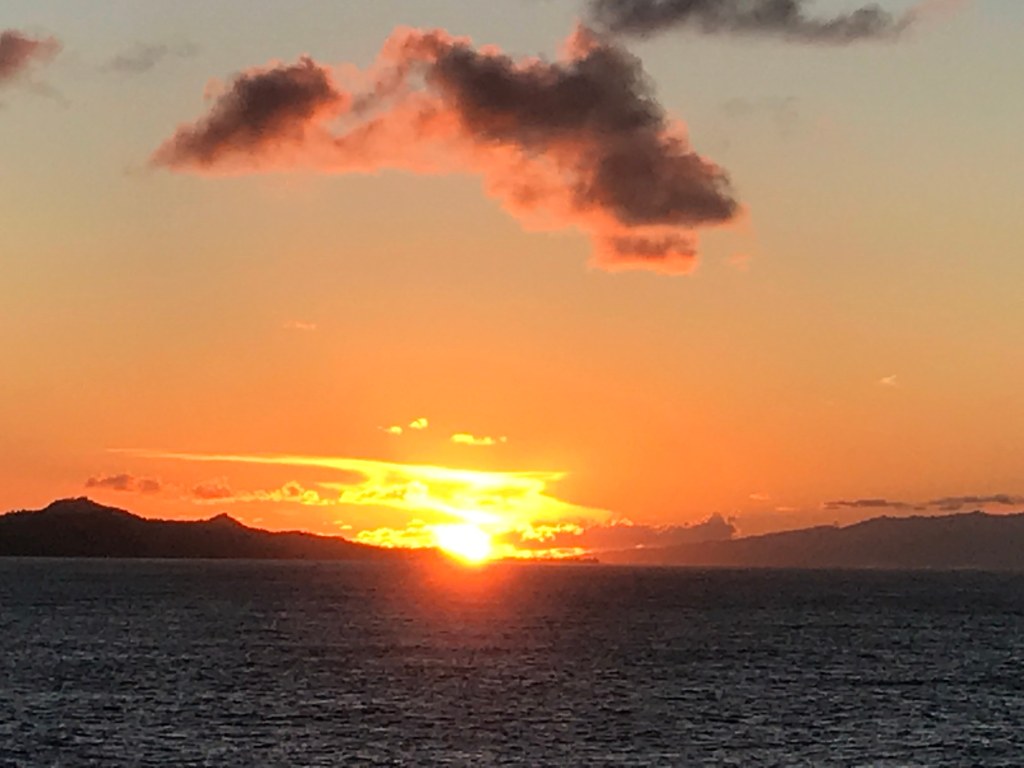
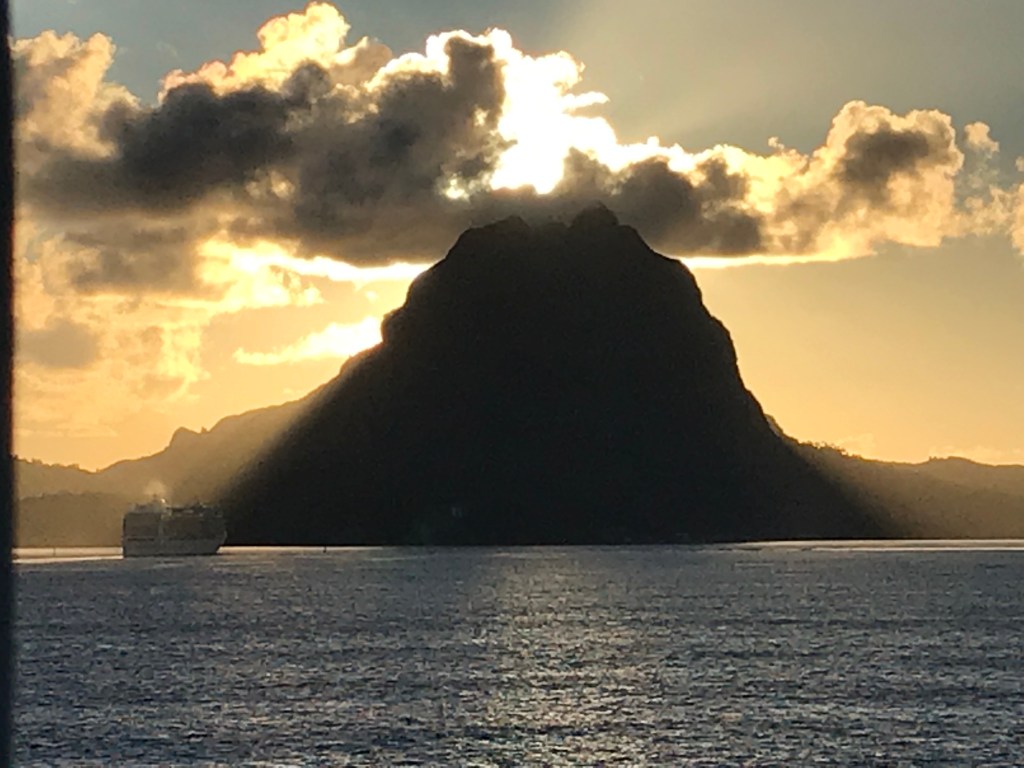
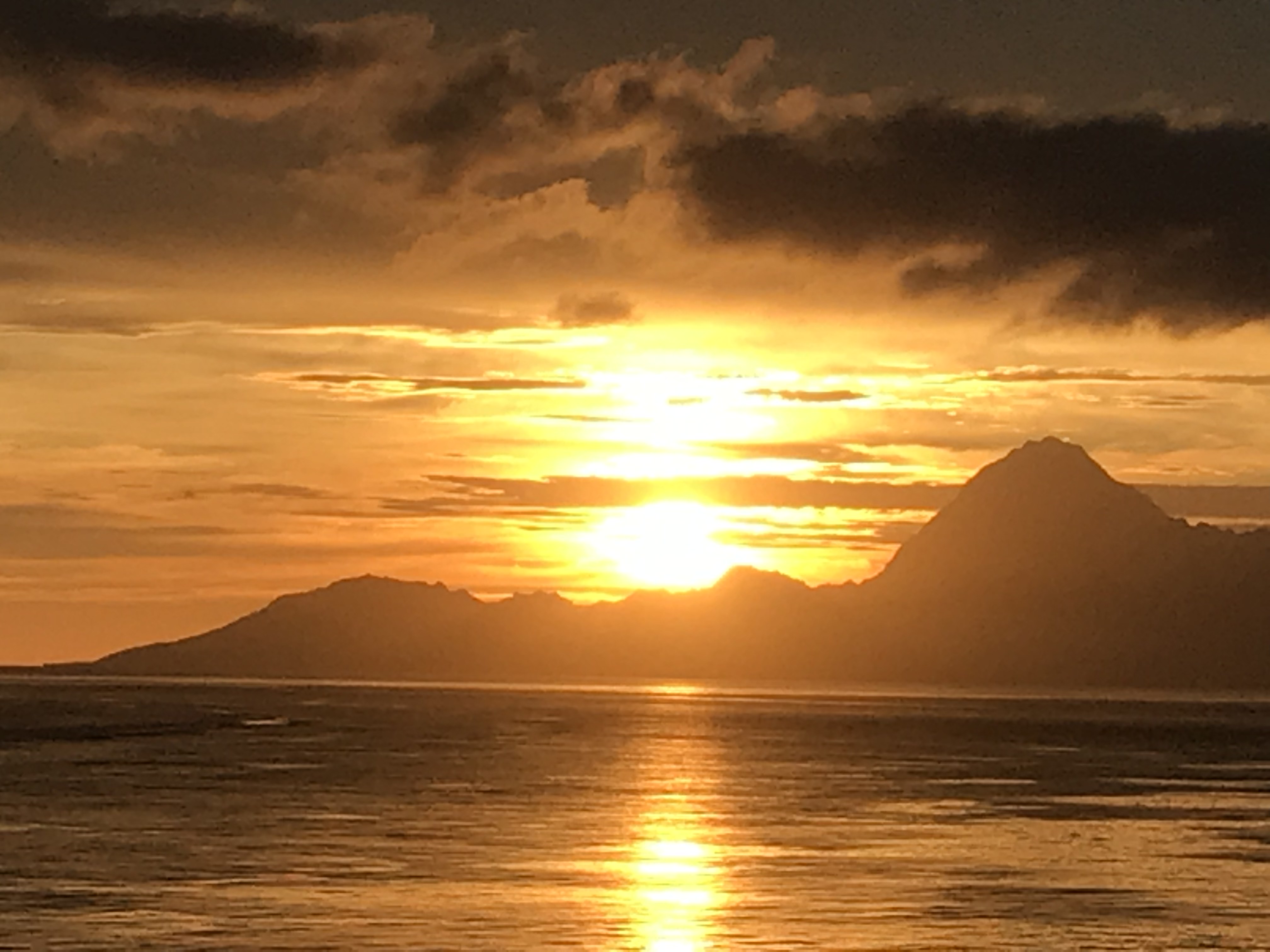
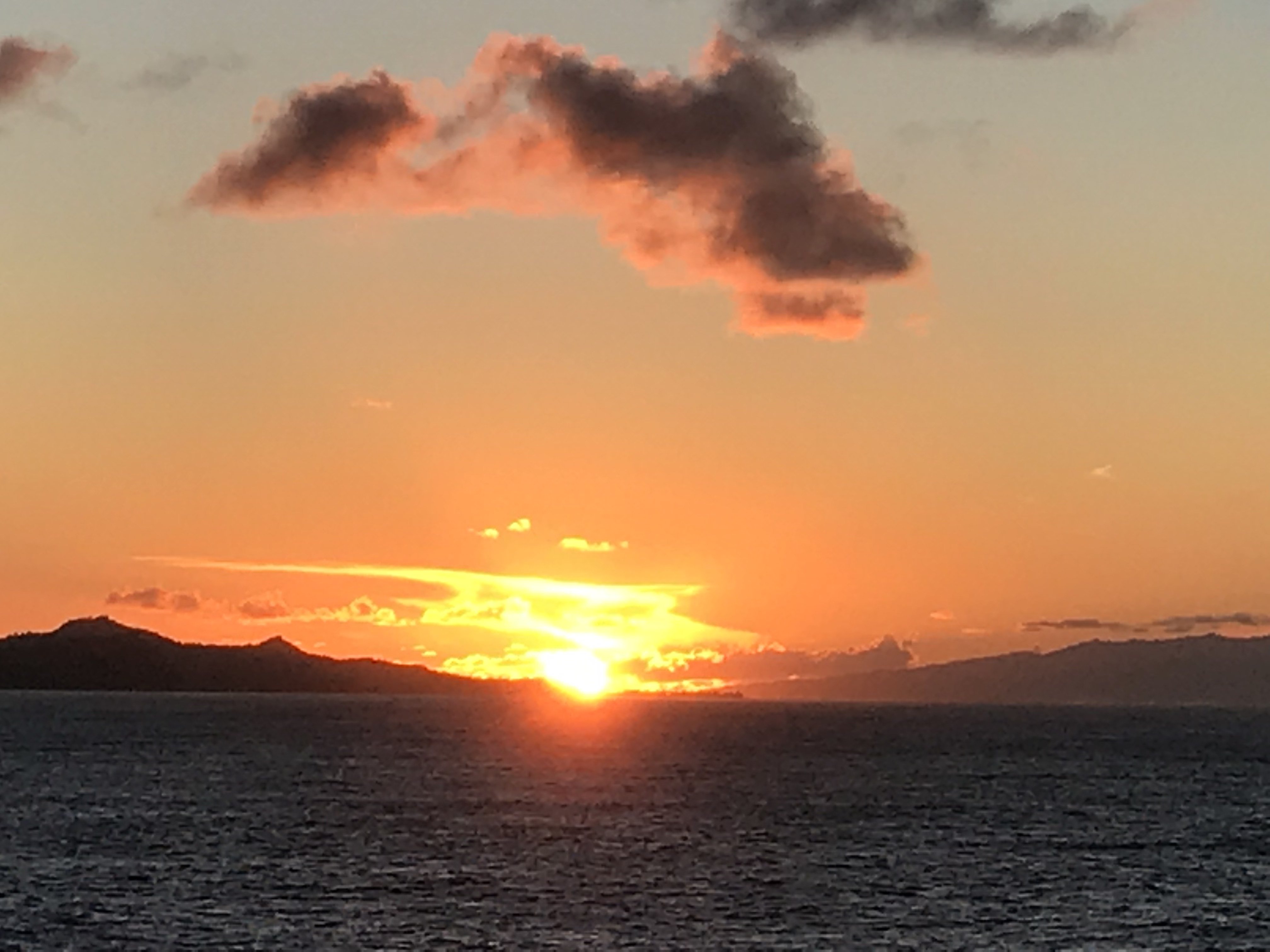
We wakened at 6 am to watch the sail in to Bora Bora, its incredible lagoon, and nearby islands— sunrise photos to match the sunset photos from the night before. (I may have mixed up some of the sunset and sunrise photos, but they’re still lovely skies.)
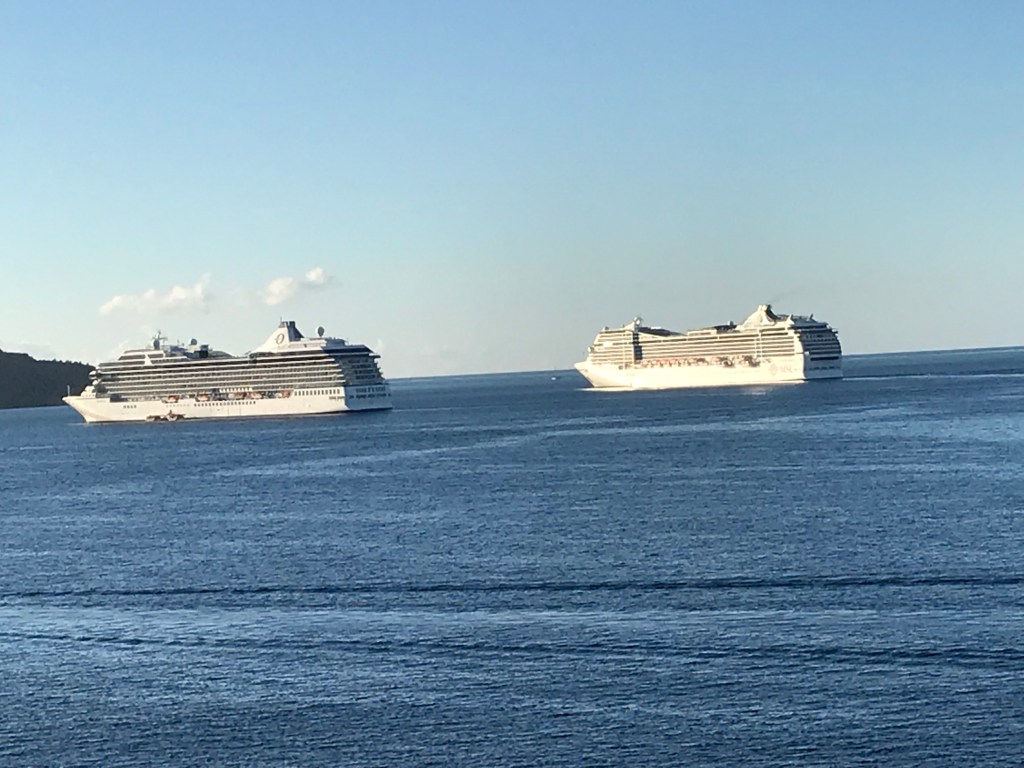
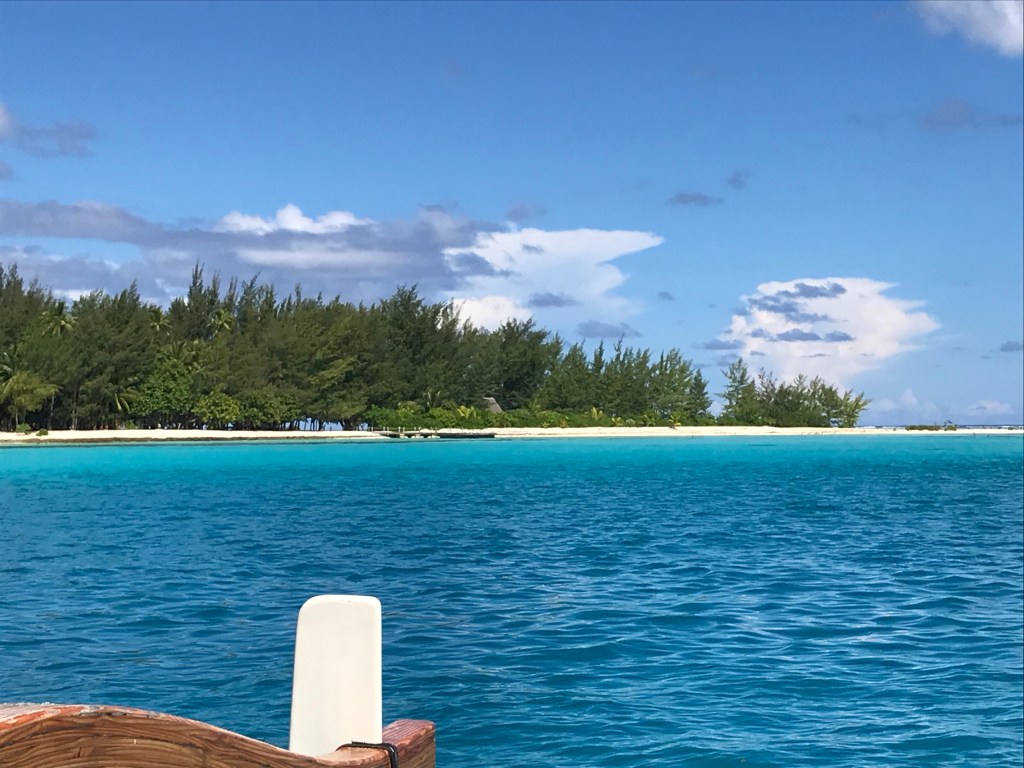
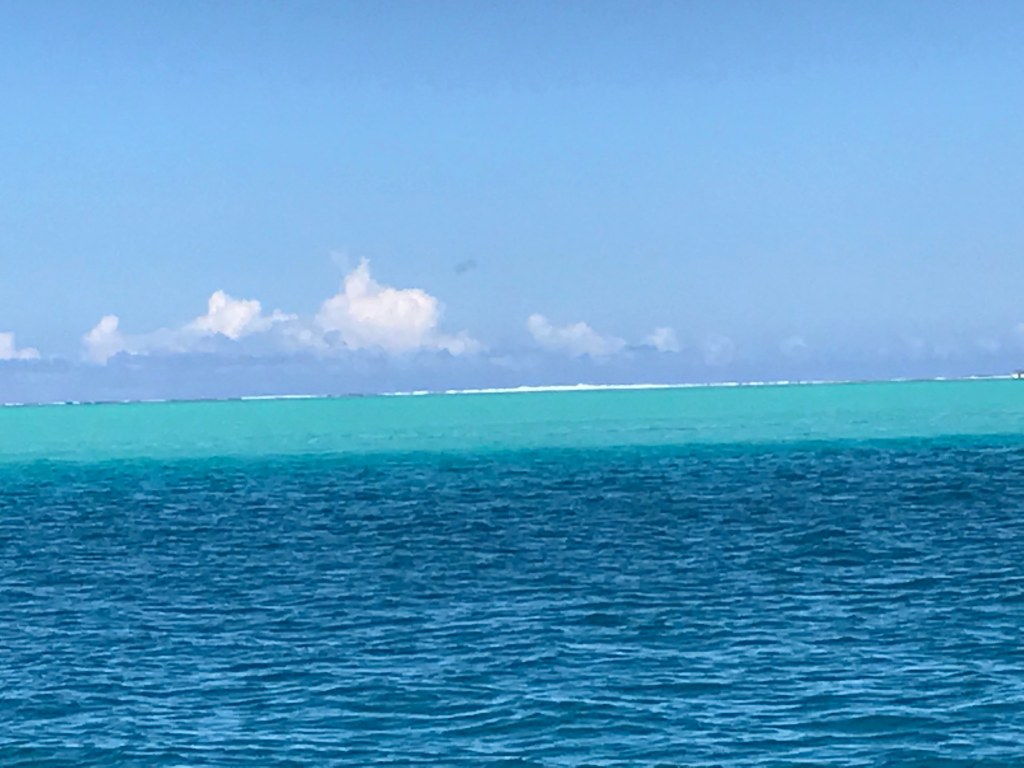
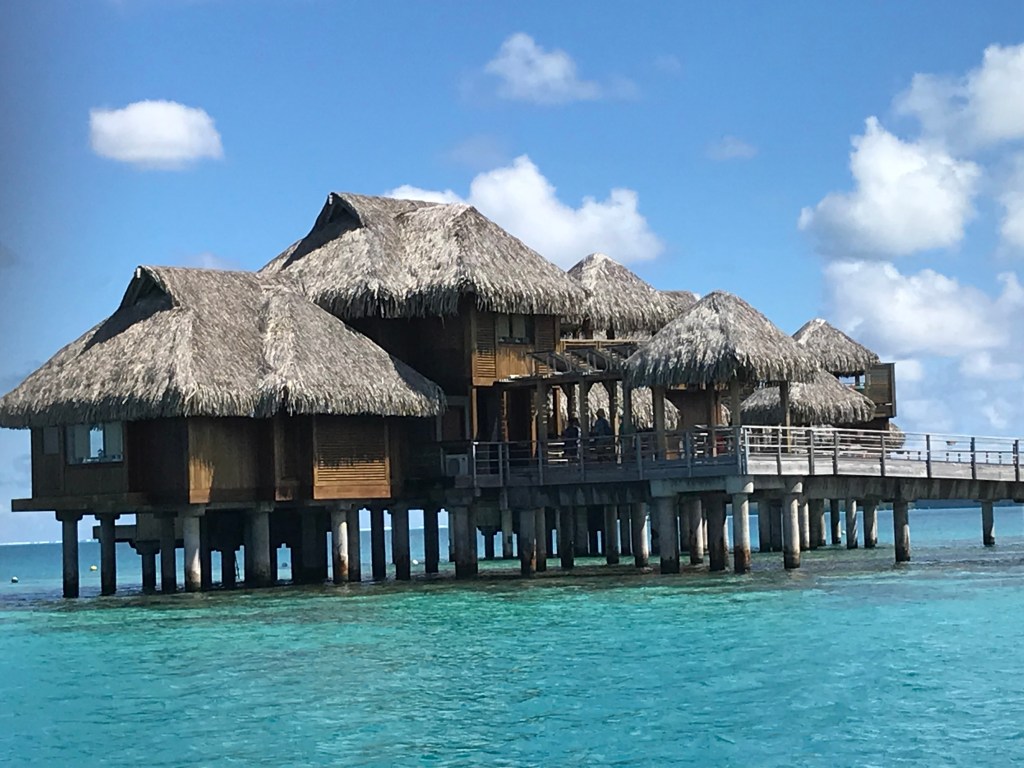
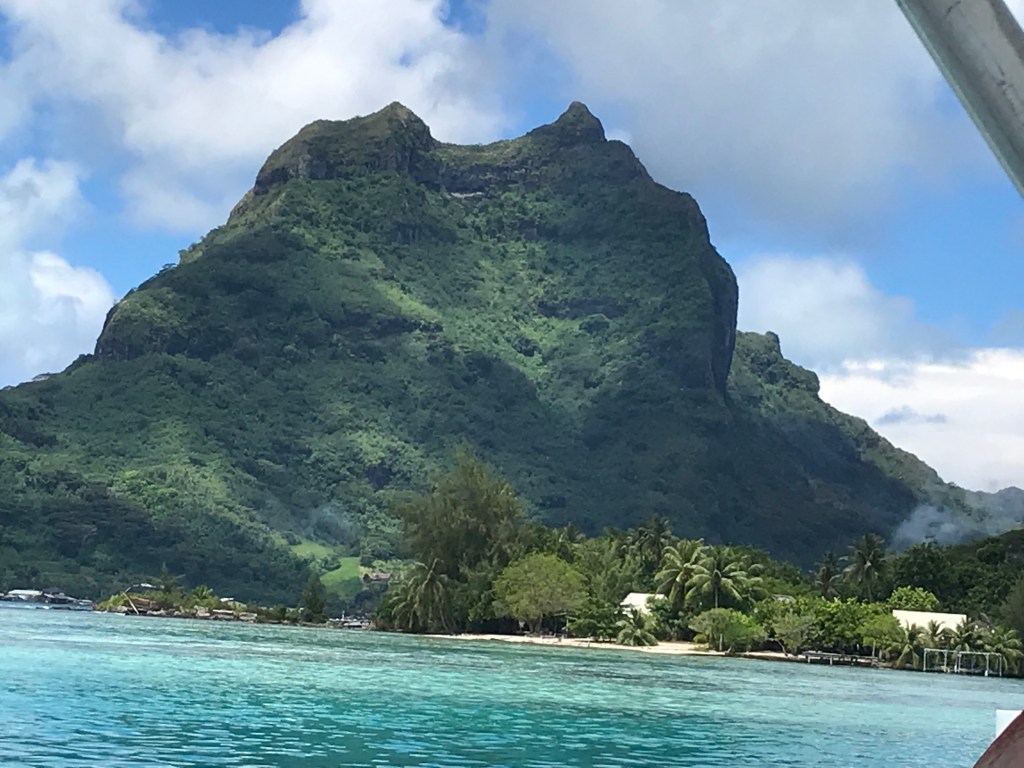
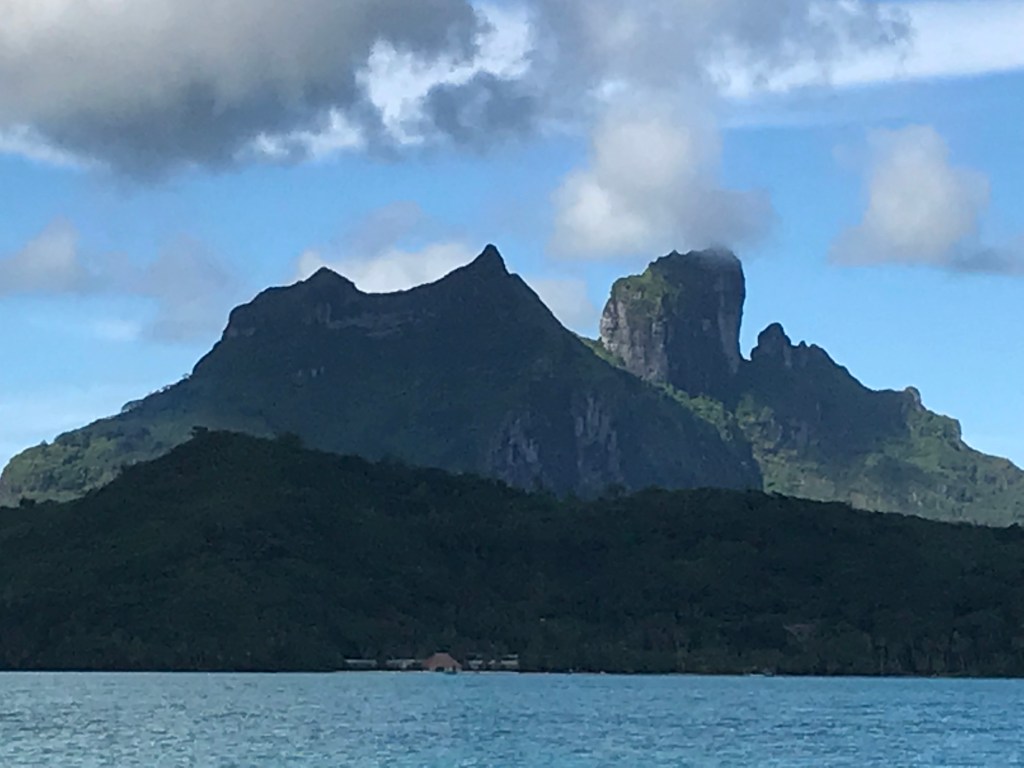
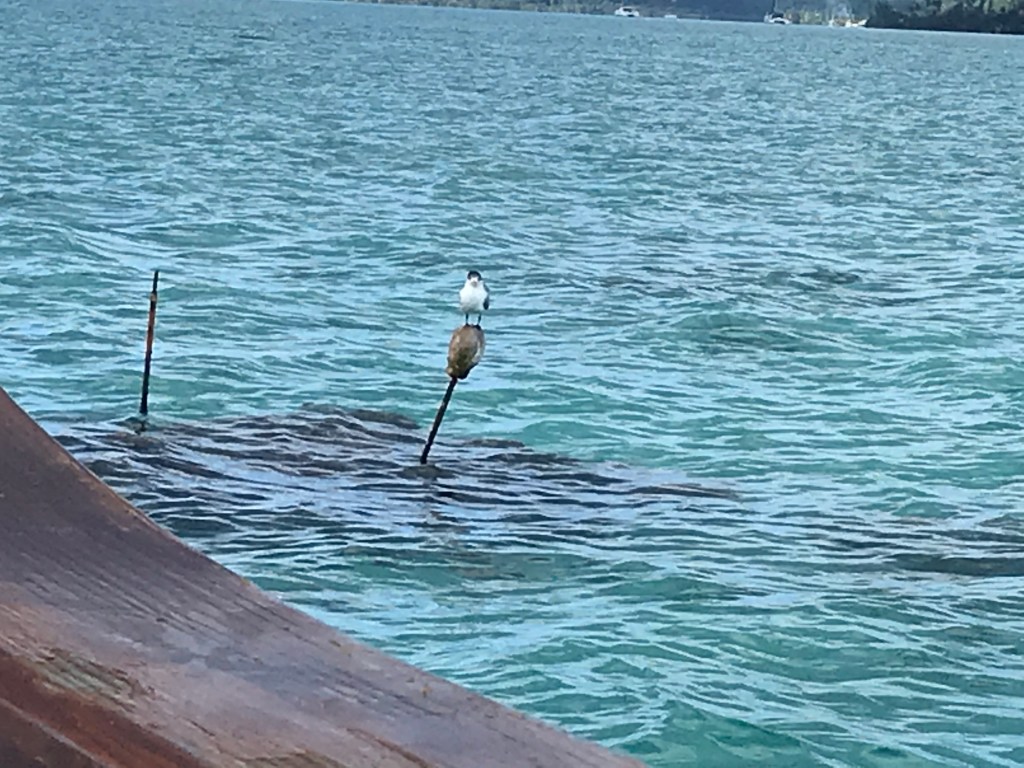
These islands are, of course, volcanic, resulting in impressive jagged peaks and valleys. Bora Bora is surrounded by a coral reef creating a huge lagoon around the island, whose shallow waters are a beautiful, almost improbable, shade of aqua. We anchored in what was the center of the crater and, thus, deeper than the rest of the lagoon (entering through the only break in the reef) and found we were the third ship there.
One ship
was an MSC ship, a South American cruise line whose ships we have encountered
in many ports; the other from the Oceania cruise line. I was told by a fellow passenger the Oceania
cruise was what is called an Atlantis cruise meaning its passengers are all gay
men. Our guide said he’d never seen
three ships at a time. So it was a busy
place today, but Viking is very good about arranging shore excursions and we
were fine.
Bora
Bora has a population of about 10,000 and the largest settlement is the village
of Vaitape to which we tendered. Viking
cruises offer one included tour each port plus several other tours available at
an additional charge—though included in our world cruise is quite a bit of
‘shipboard credit’ allowing us to sign up for optional tours without actually
paying additional money. I think this is
a very clever and helpful arrangement—you can take a lot of tours but only run
into paying cash if you do a lot of the high end tours (helicopter rides,
overnight safaris or flights to waterfalls).
Anyway,
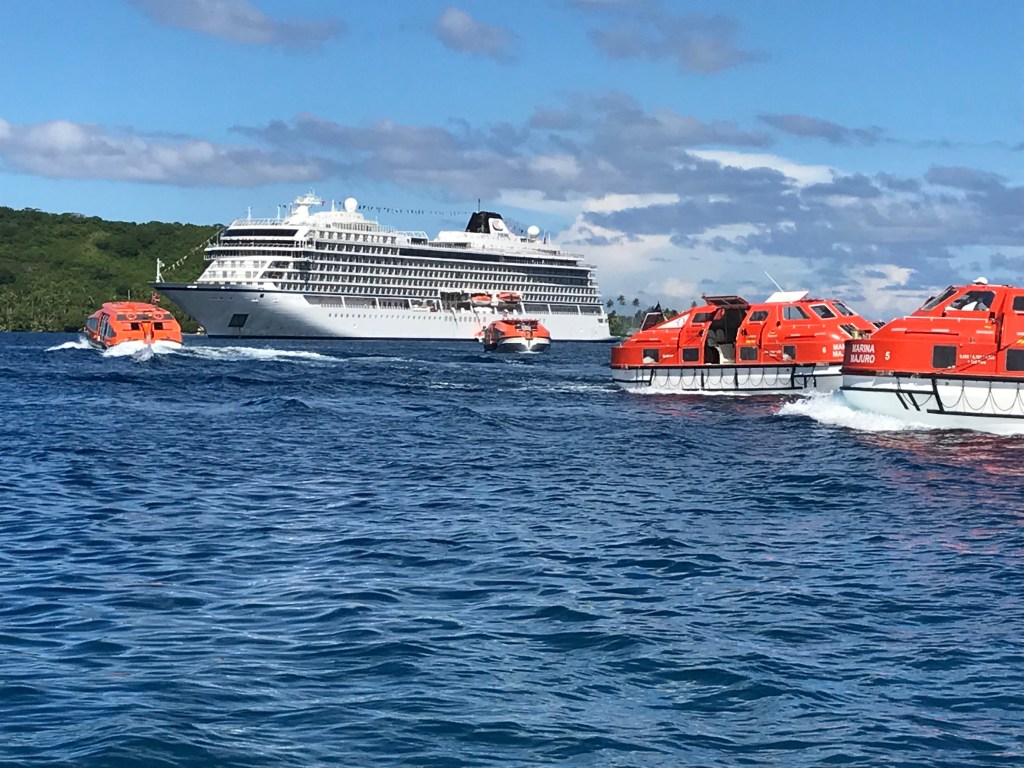
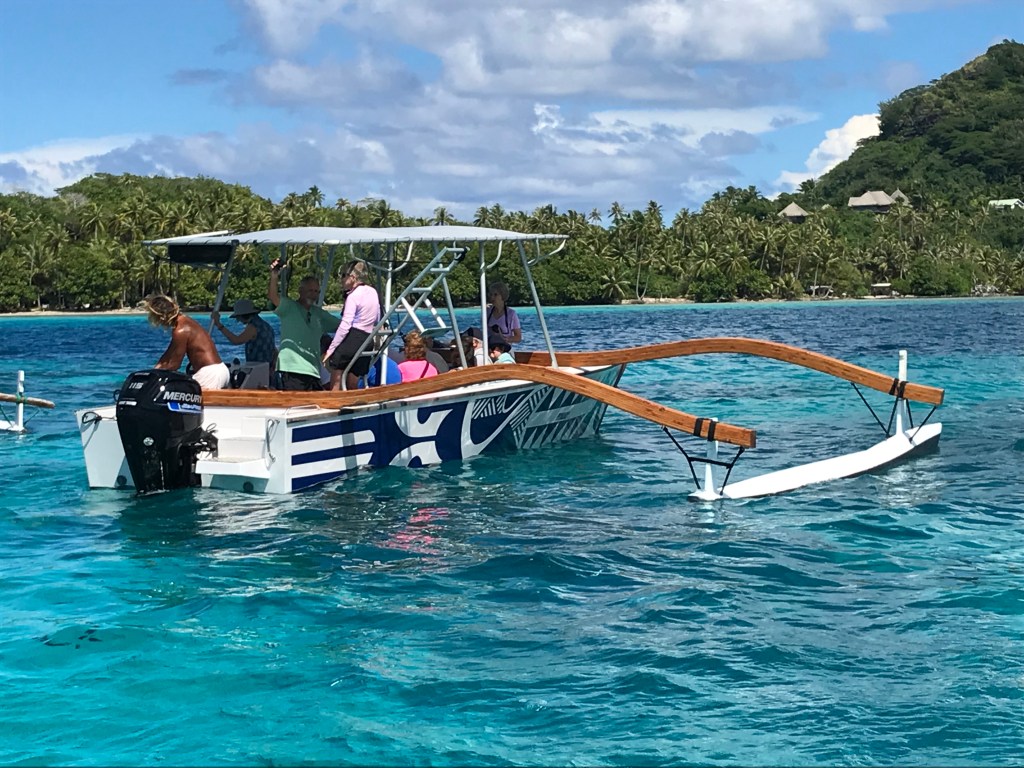
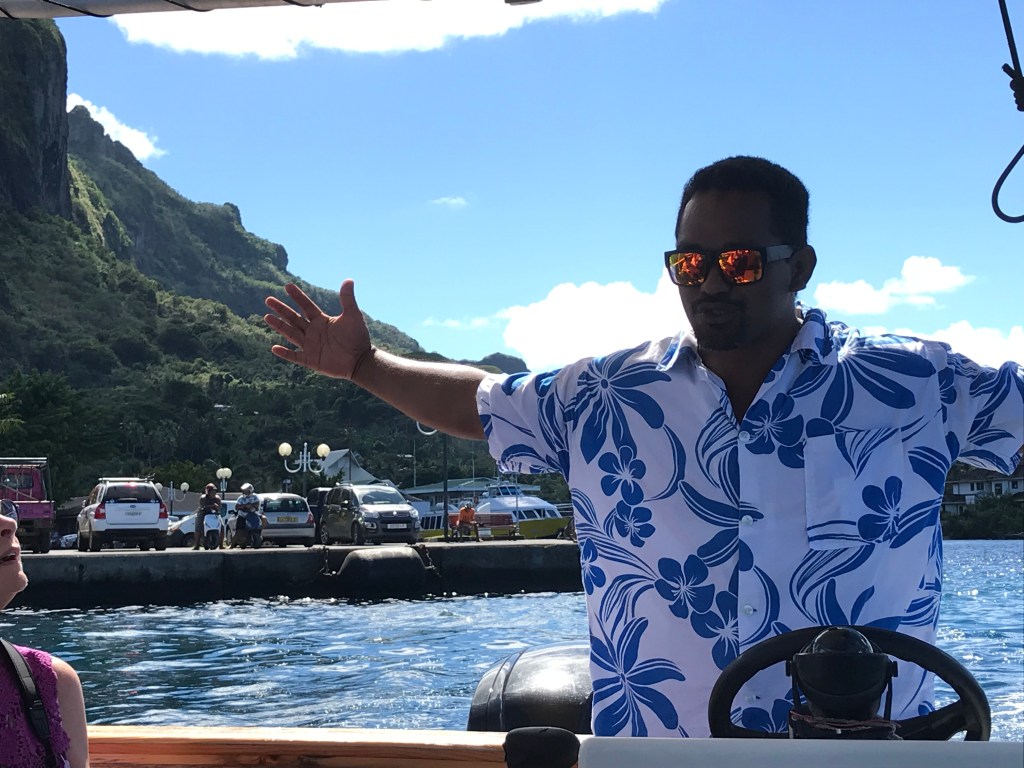
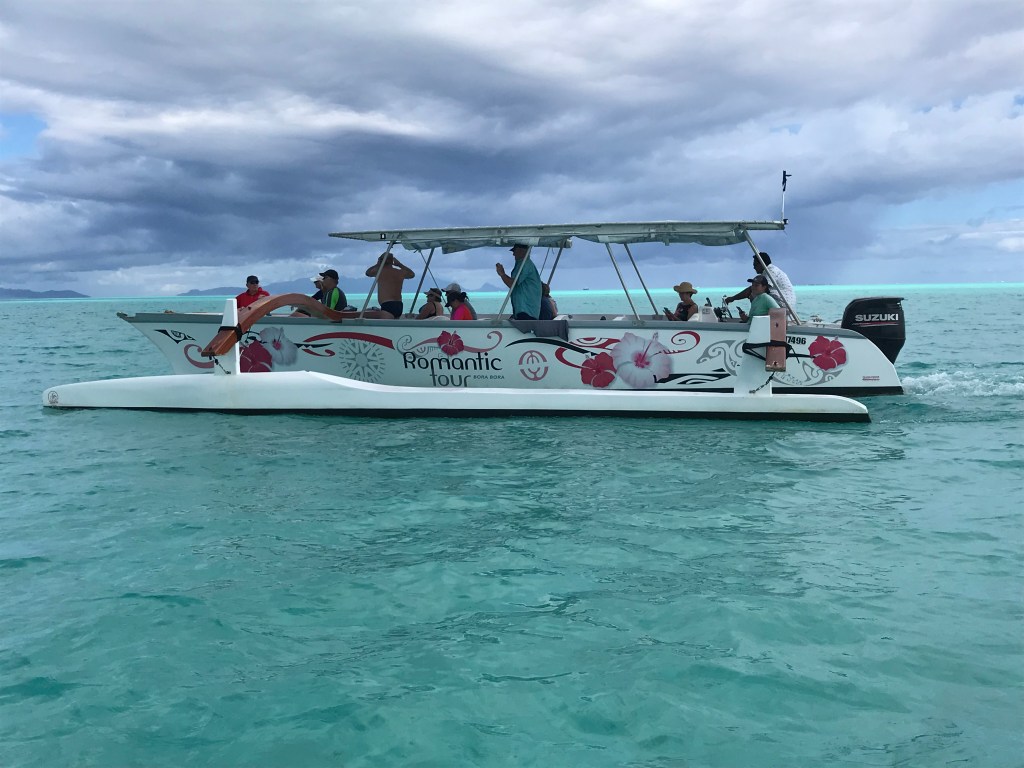
the included tour is usually a walking tour or a ‘panoramic’ bus tour. In Bora Bora it was a ride around the lagoon
in outrigger boats. Outriggers have
’attached lateral support floats’ on one side (see photo above). A traditional
form, outriggers have been used in Polynesia for centuries including by the
early explorers who migrated to Hawaii and New Zealand among other places.
We
stopped (outriggers can moor in pairs next to each other with each boat’s
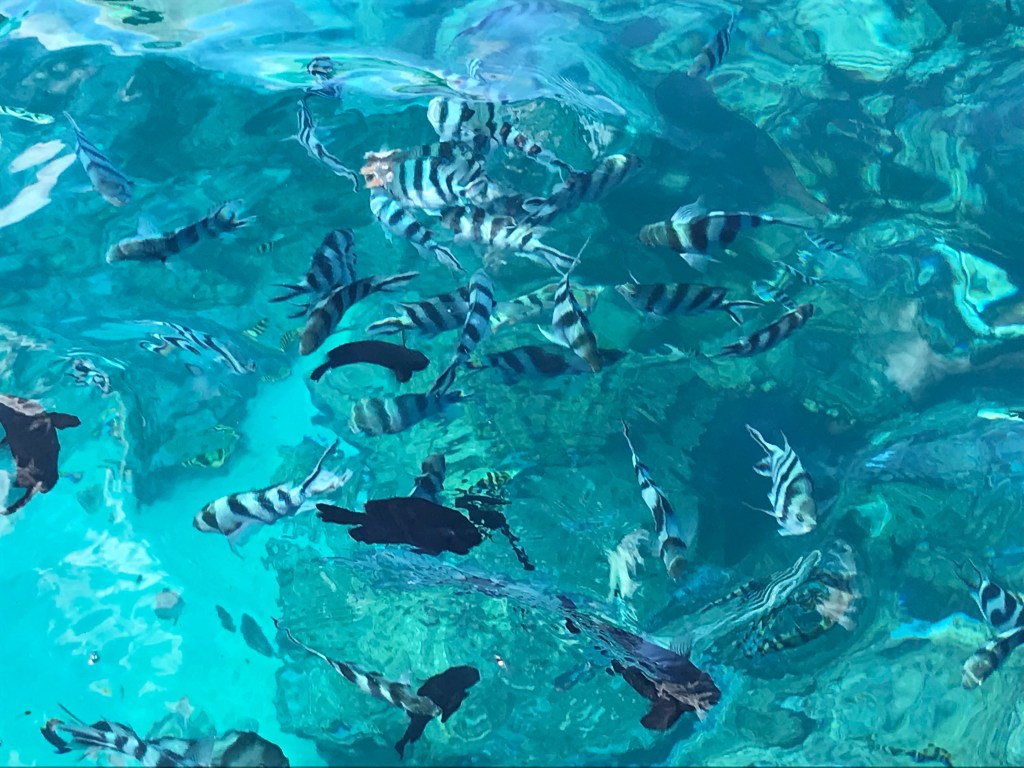
outrigger away from the other boat) to look at tropical fish and made our way
around the lagoon and an offshore island.
Fantastic! We all thought this was the best included tour of the
trip.
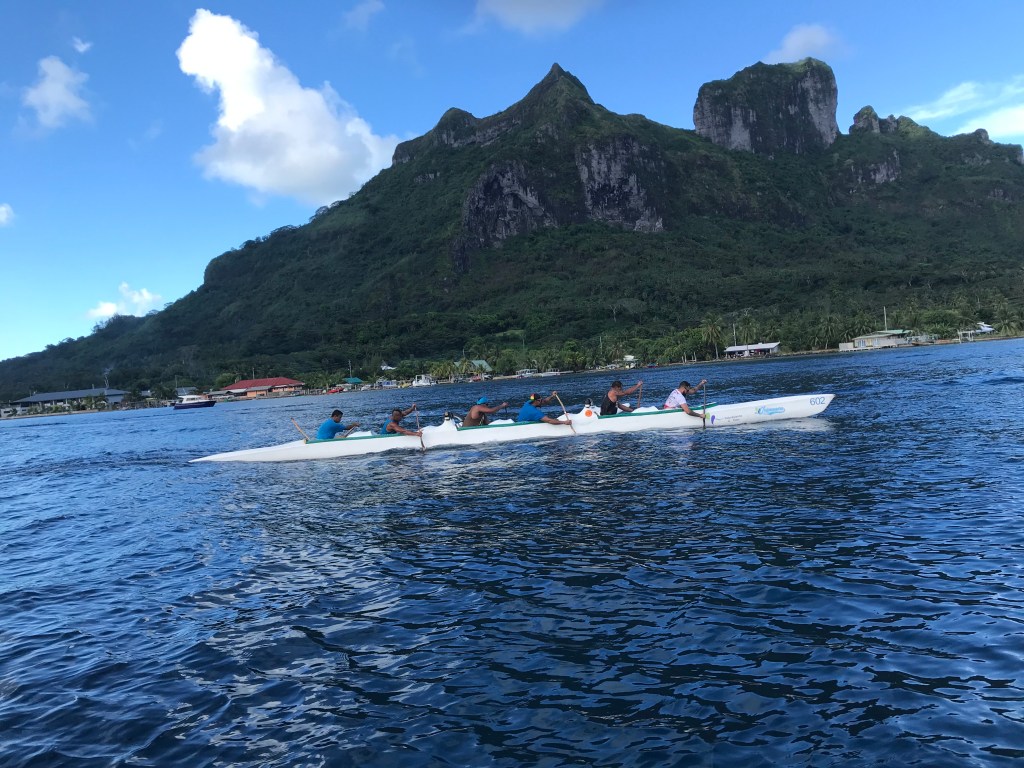
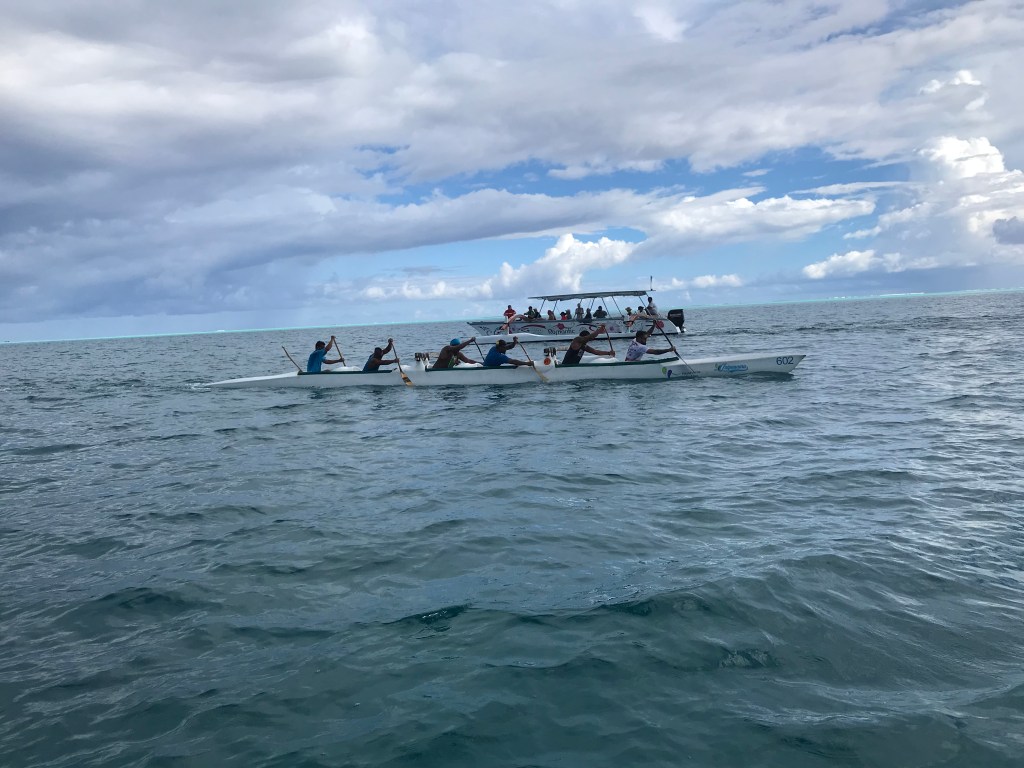
Canoes are also popular all around Polynesia. There are 1, 2, and 6 man canoes, and the Polynesians are world champions in racing all of them. In the lagoon some of the single canoes enjoyed racing the tenders or coming behind to surf the wake. In the afternoon we saw some 6-man canoes moving incredibly fast as well. We were told there is an upcoming race to prepare for.
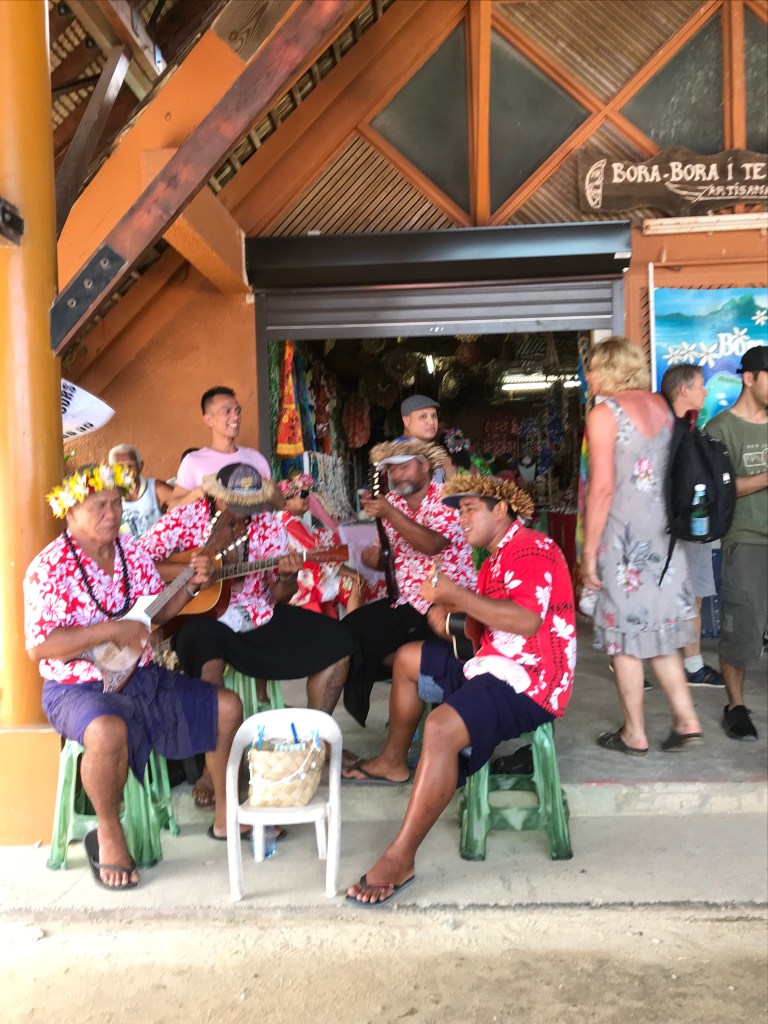
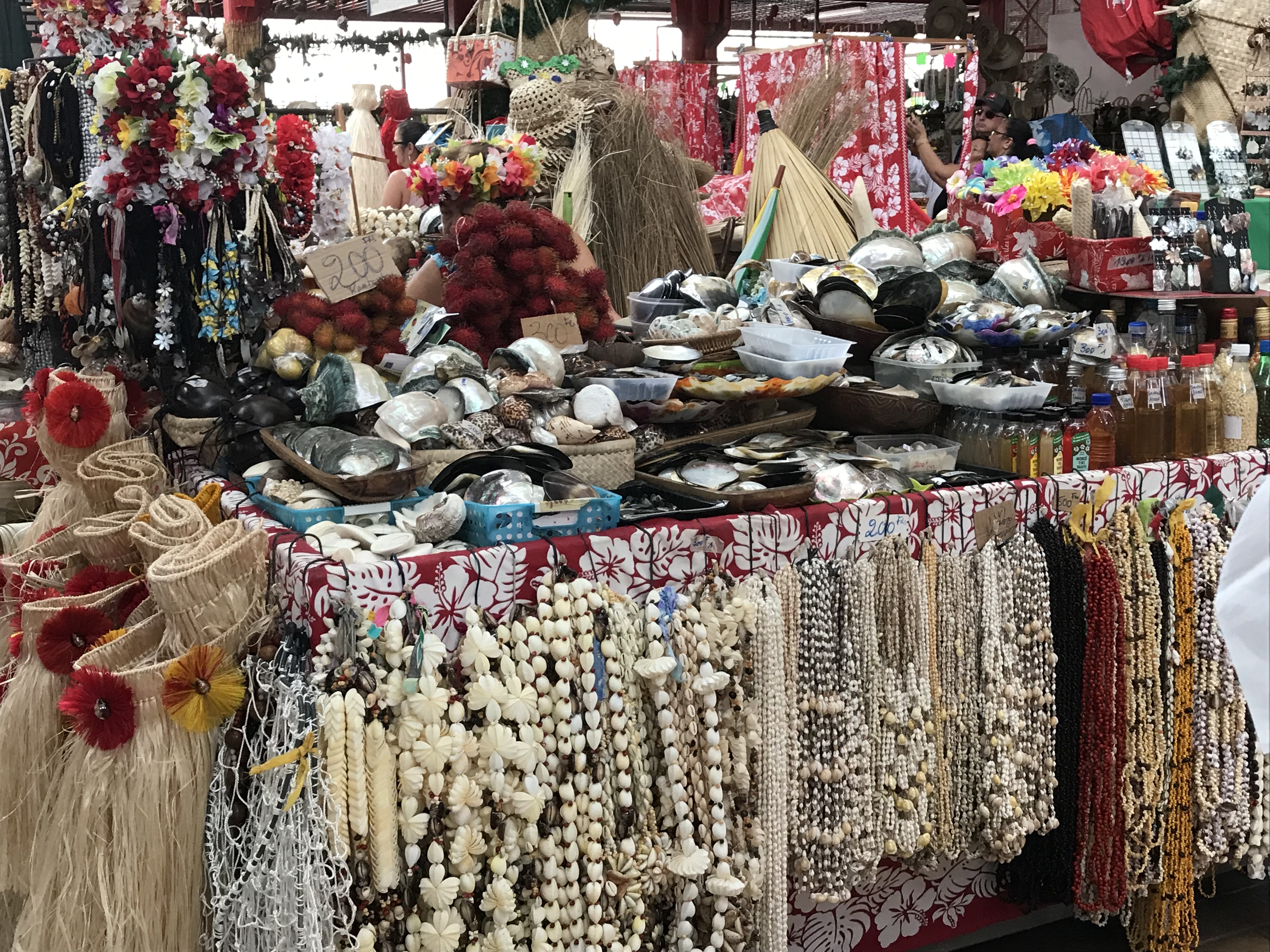
After a trip back to the ship for lunch, I returned to the island for a little shopping and a snorkeling trip. The big item for sale is Tahitian pearls, especially black pearls (as, of course was also the case in Tahiti), but I managed to resist them. As in South America, at the crafts market I was amazed that prices are quoted in dollars as well as francs and they are happy to take dollars—even give change in dollars—but aren’t set up to do credit cards. We mainly brought dollars for tipping tour guides so using them for purchases rather depletes our stash. I expect we’ll just get local money for tipping in the countries where we have several stops (New Zealand, Australia, South Africa) to make up.
Snorkeling
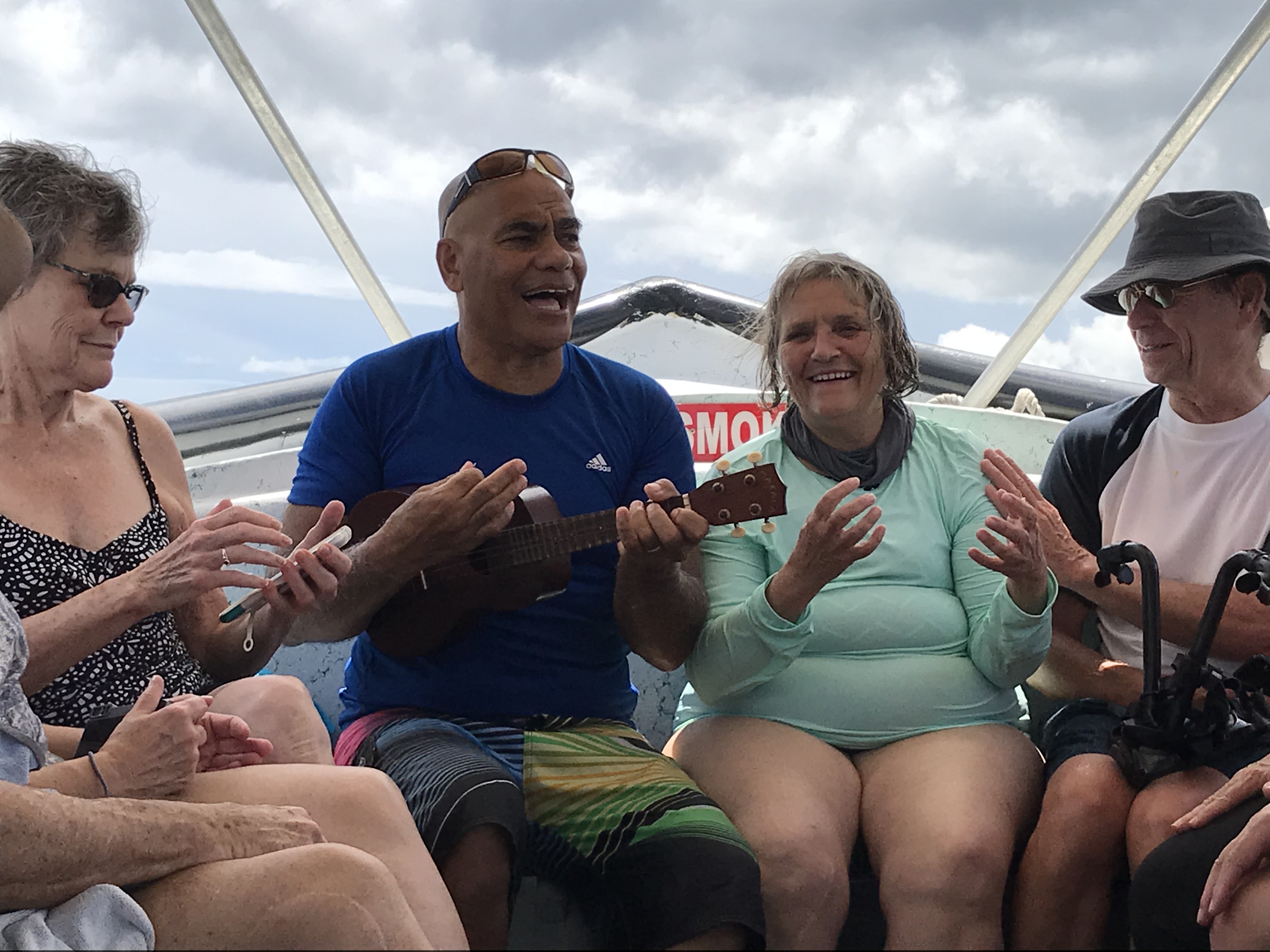
among sting rays and blacktip sharks was quite an adventure! Again a small outrigger with 10 passengers,
we moored in a sandy area. The sea
creatures swarmed around us (especially when the guide threw food into the
water) but unerringly avoiding touching us through there were probably 40
swimmers in the area (and standers because it was shallow enough to stand
up). Amazing creatures! The rays are beautiful and so graceful. The sharks, about 5 feet long, were uninterested
in us, though Wikipedia calls them both timid and able to become aggressive
around food.
For our second stop we went farther out, to the reef, where there was coral. Rays and sharks were there too, but there were fish and other sea creatures as well. I saw a big sea cucumber (looks like a giant turd), but my favorite sight was a multitude of giant clams mostly embedded into the coral. They look like brilliant blue and purple giant rickrack, and you could actually see them open and close. I’ve included a photo from the internet (I don’t have an underwater camera, and I’ve learned not to put my phone under water…) An altogether satisfying day although at one point, the guide picked up a ray by its wings (I disapprove) and swung it around. I was swimming nearby looking at the bottom and he swung it into my neck. I was startled and unhappy, and I doubt the ray liked it any better than I did. Another passenger told me that they catch the rays annually and cut off their stinging barb.
We
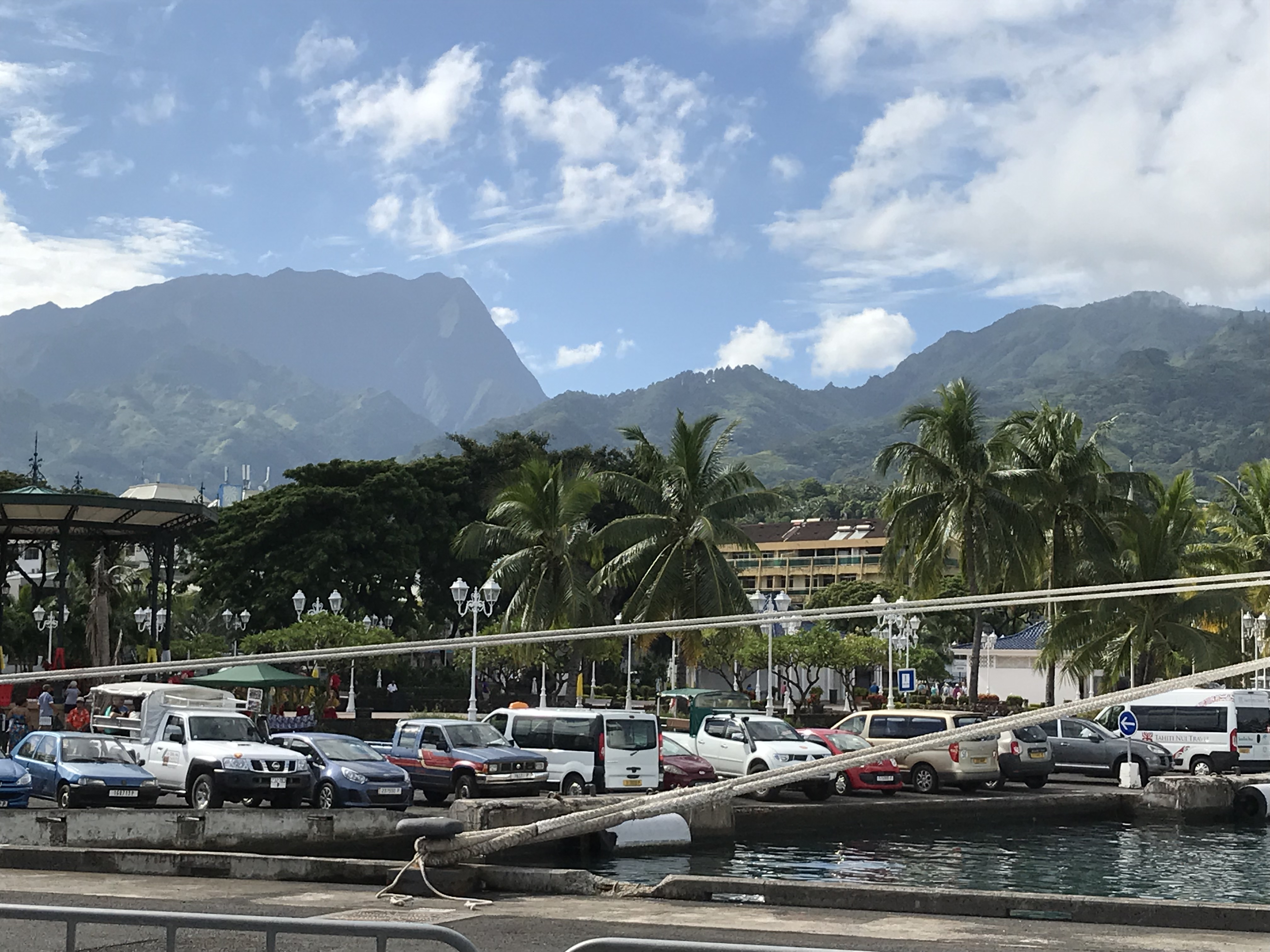
sailed into Papeete (pa-pe-et-ay) late in the afternoon. We were scheduled to arrive the following
morning, but, since the Easter Island landing was aborted, we had a little
extra time—and perhaps they wanted to make up to us for missing Easter
Island. Apparently several people were bitterly
disappointed and complained vociferously—some saying it was the main reason
they had chosen the cruise. I admit,
when people asked us before we left what we were looking forward to most, we
mentioned Easter Island ourselves. I
think Viking could have prevented some of the complaints had they been
forthcoming in the cruise description about Easter Island (and actually the
other tender ports) being potentially unsuccessful.
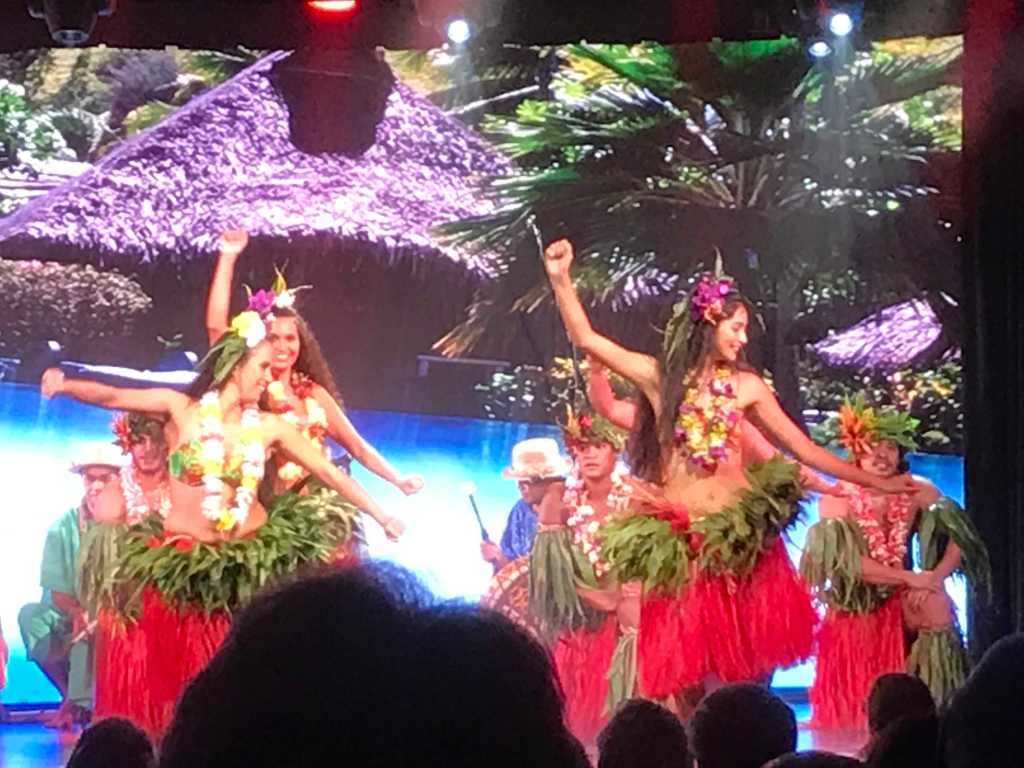
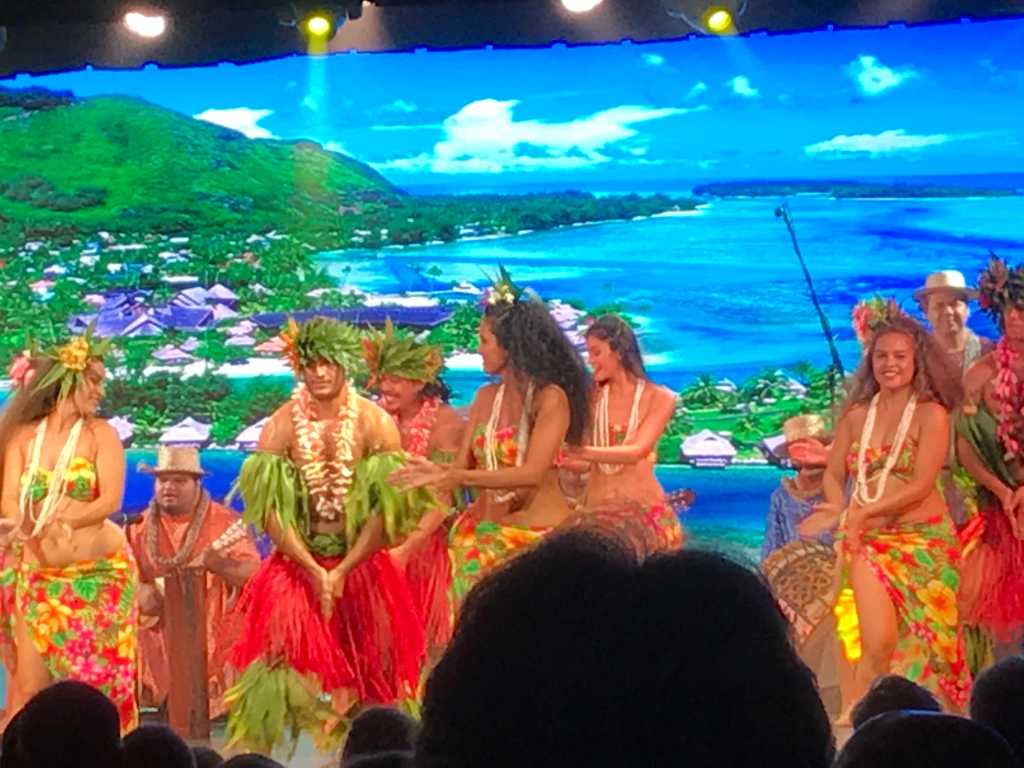
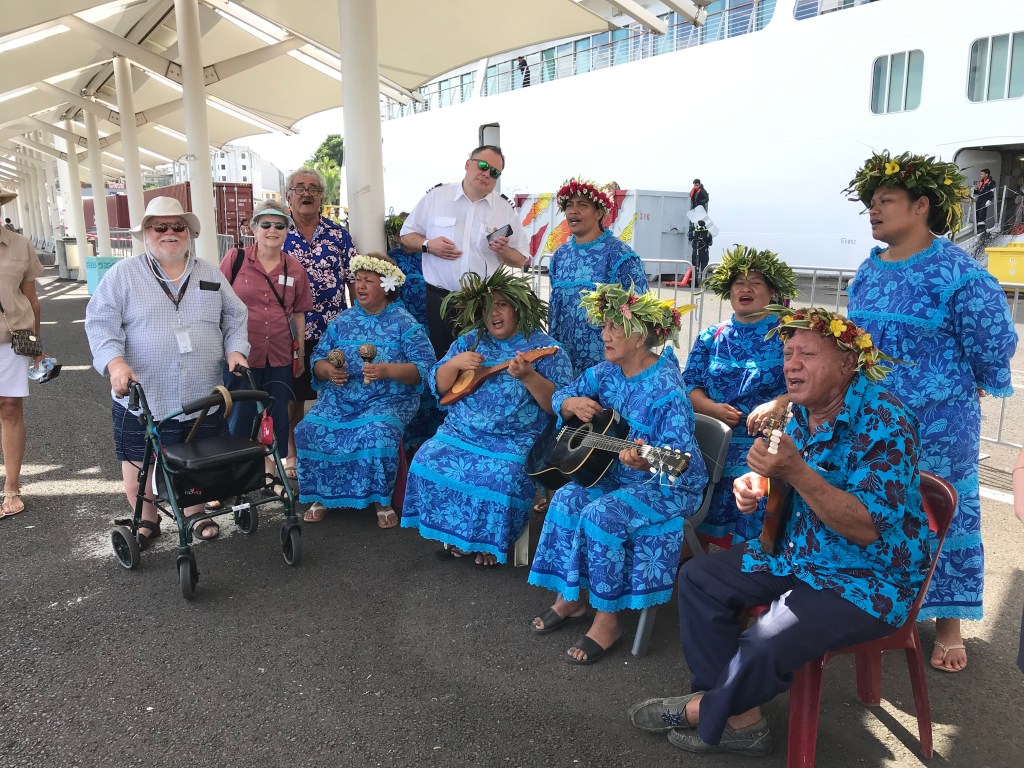
At any rate, the overnight in Tahiti allowed the ship to bring aboard ‘O Tahiti E’ for a performance of Tahitian music and dance that was well-received—even we enjoyed it immensely and, indeed, arrived in the theater an hour plus early in order to assure seats. The theater seats about 400 I think and I believe we have about 830 passengers (somewhat fewer during this leg than the capacity 930), and, although they simulcast it on the pool deck and made it available for a day or two afterwards through our tvs, the theater seemed preferable.
French
Polynesia is part of France and the languages are French and Polynesian but
English is widely spoken. The population
of Tahiti, the largest of the French Polynesian islands, is about 200,000, most
of whom live in Papeete, the capital of both Tahiti and all of French
Polynesia.
Many
passengers went ashore when we docked, but we waited until morning when we
walked down the quay to a smaller boat and went snorkeling. It was lovely being in the water! Snorkeling made me miss diving, and I kept
forgetting I had to keep my snorkel out of the water so got a snorkelful of
water many times. There wasn’t a lot to
see– a variety of tropical fish (whose names I used to know and have
forgotten) and I did see a Christmas tree worm.
But I was delighted with the experience and ready to go again tomorrow…
In the
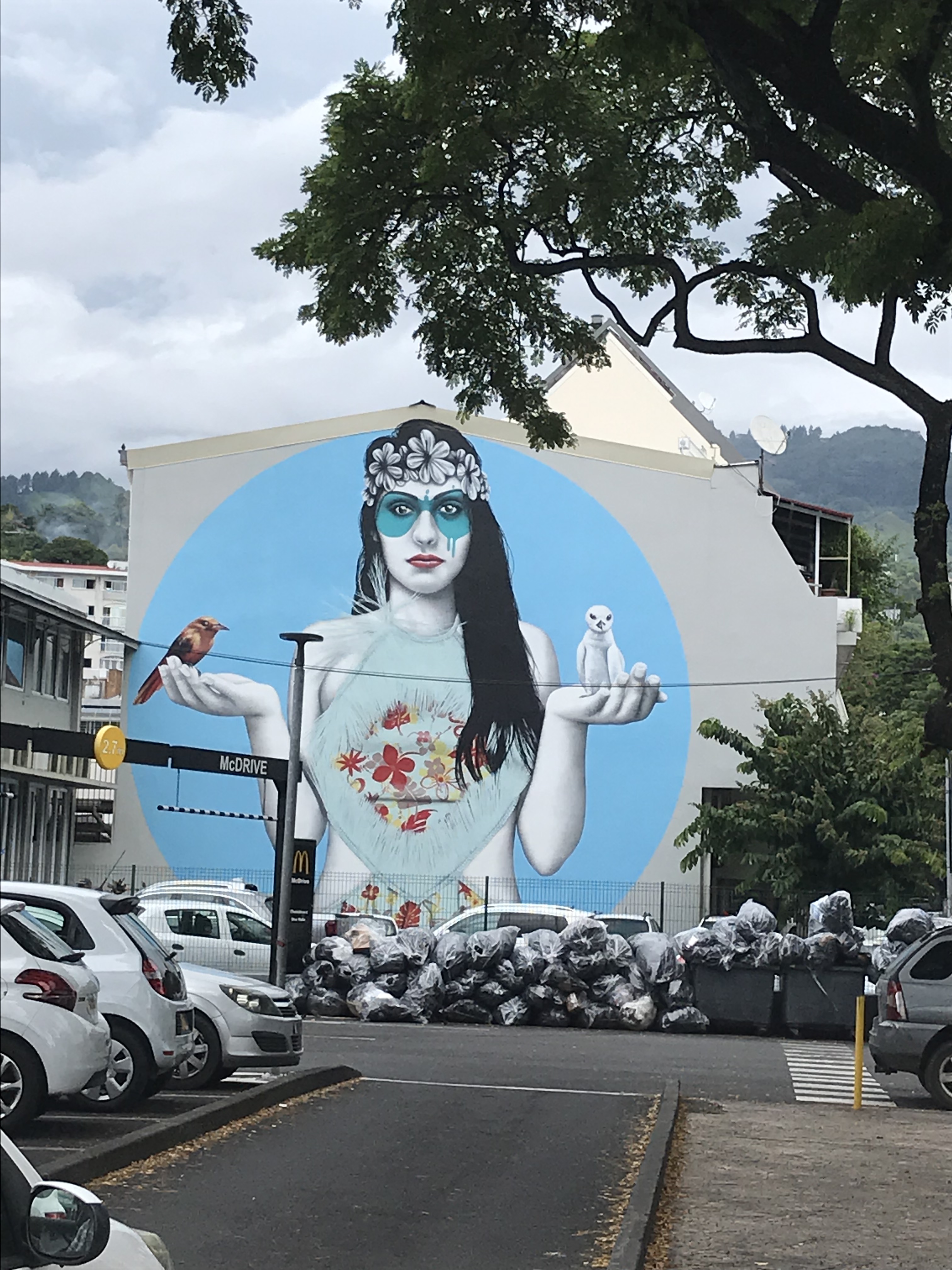
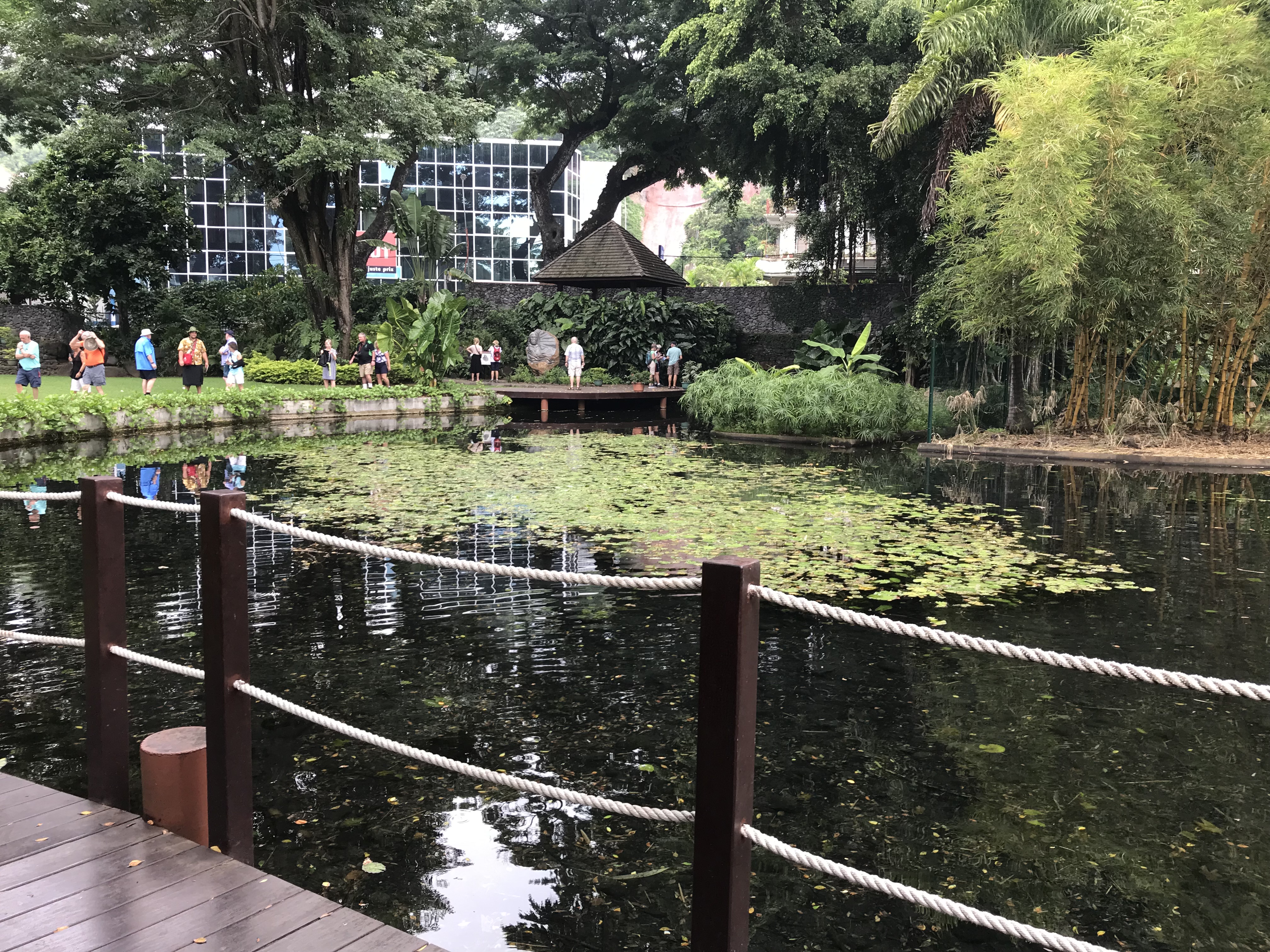
afternoon I did the walking tour around Papeete. We saw various buildings including the
parliament house and the cathedral plus the 19th century Queen’s
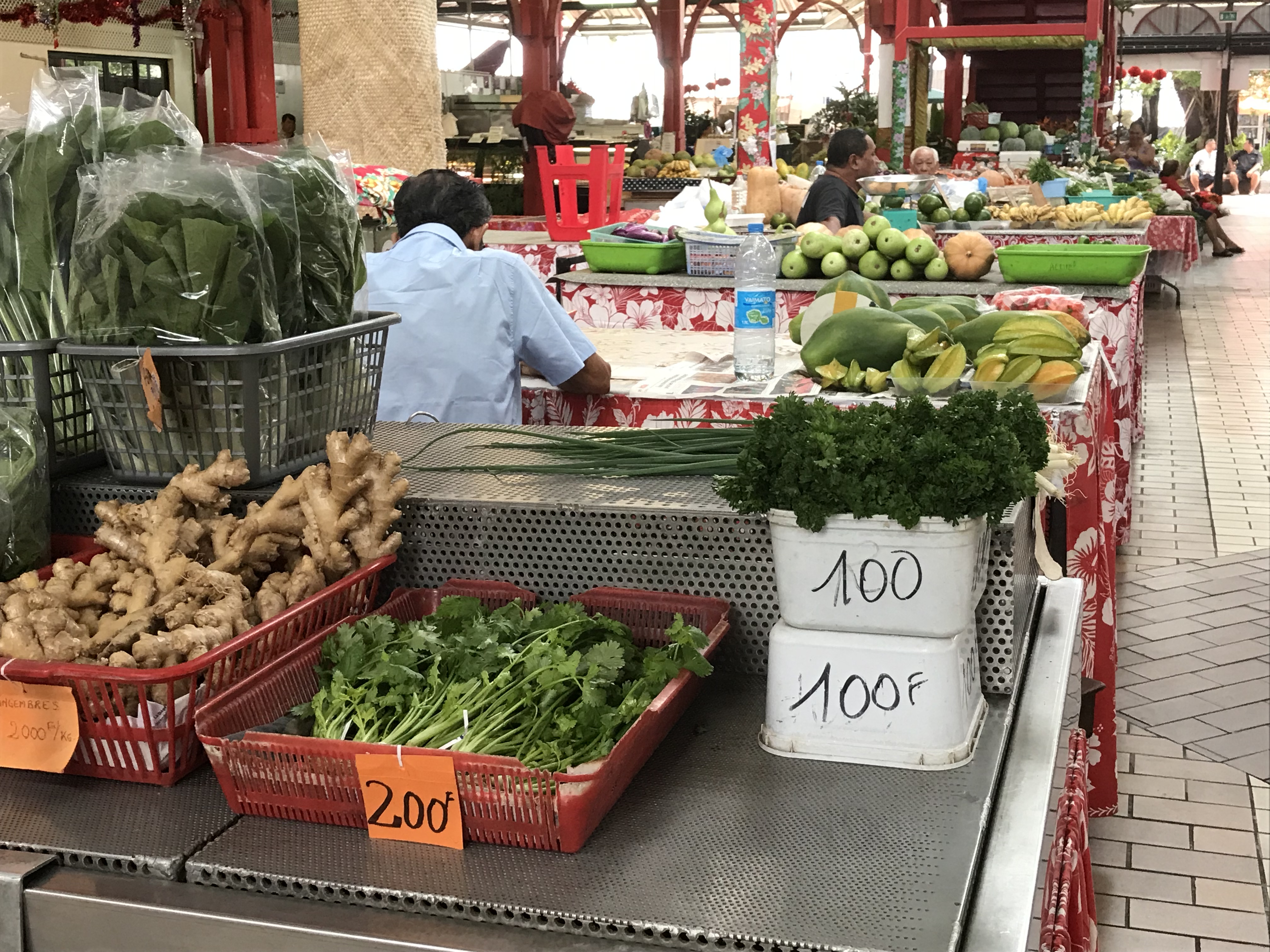
bathing pool and the Market, which was like a large farmers’ market with
produce grown at people’s homes, crafts, and flowers.
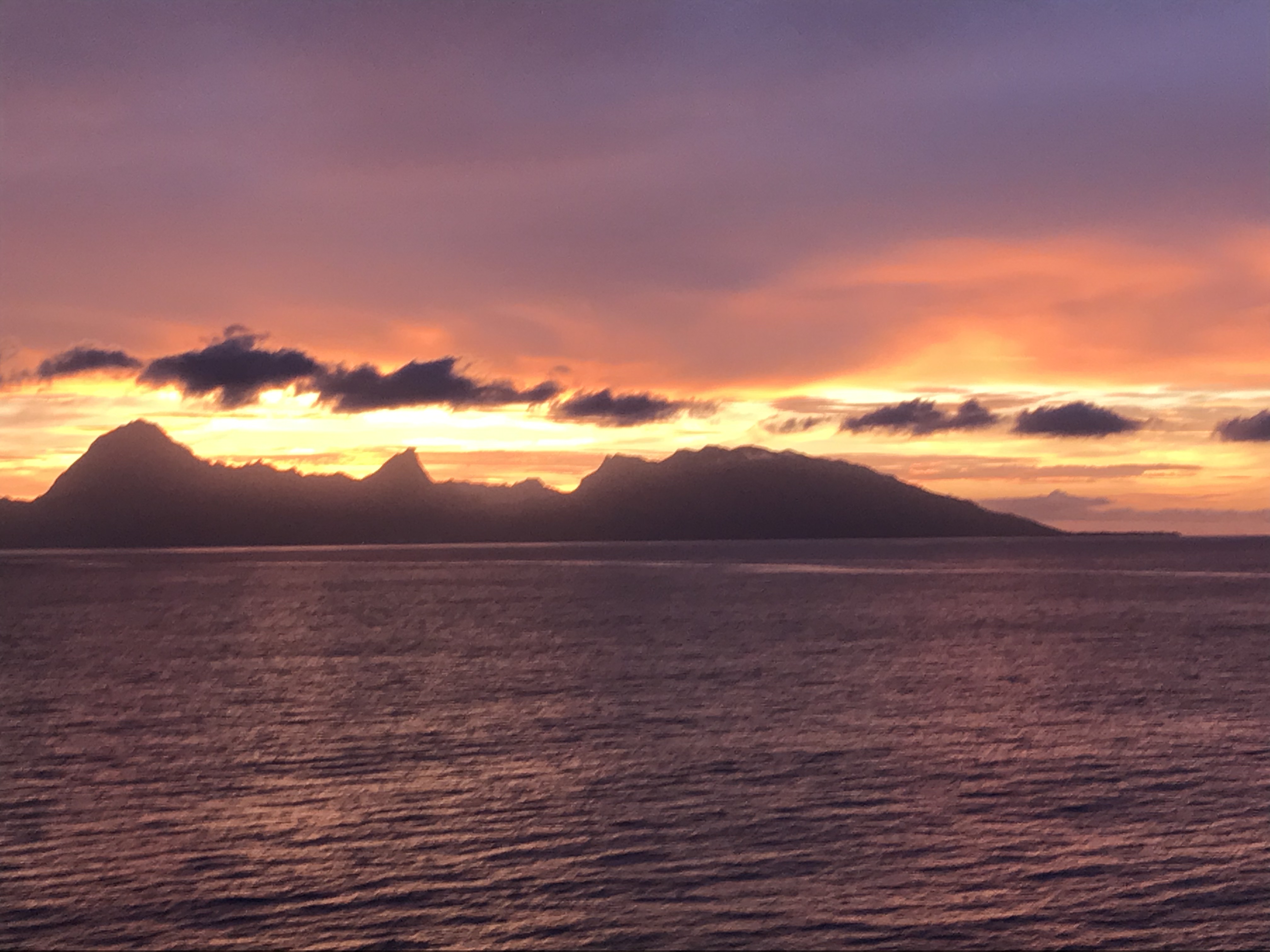
The sail
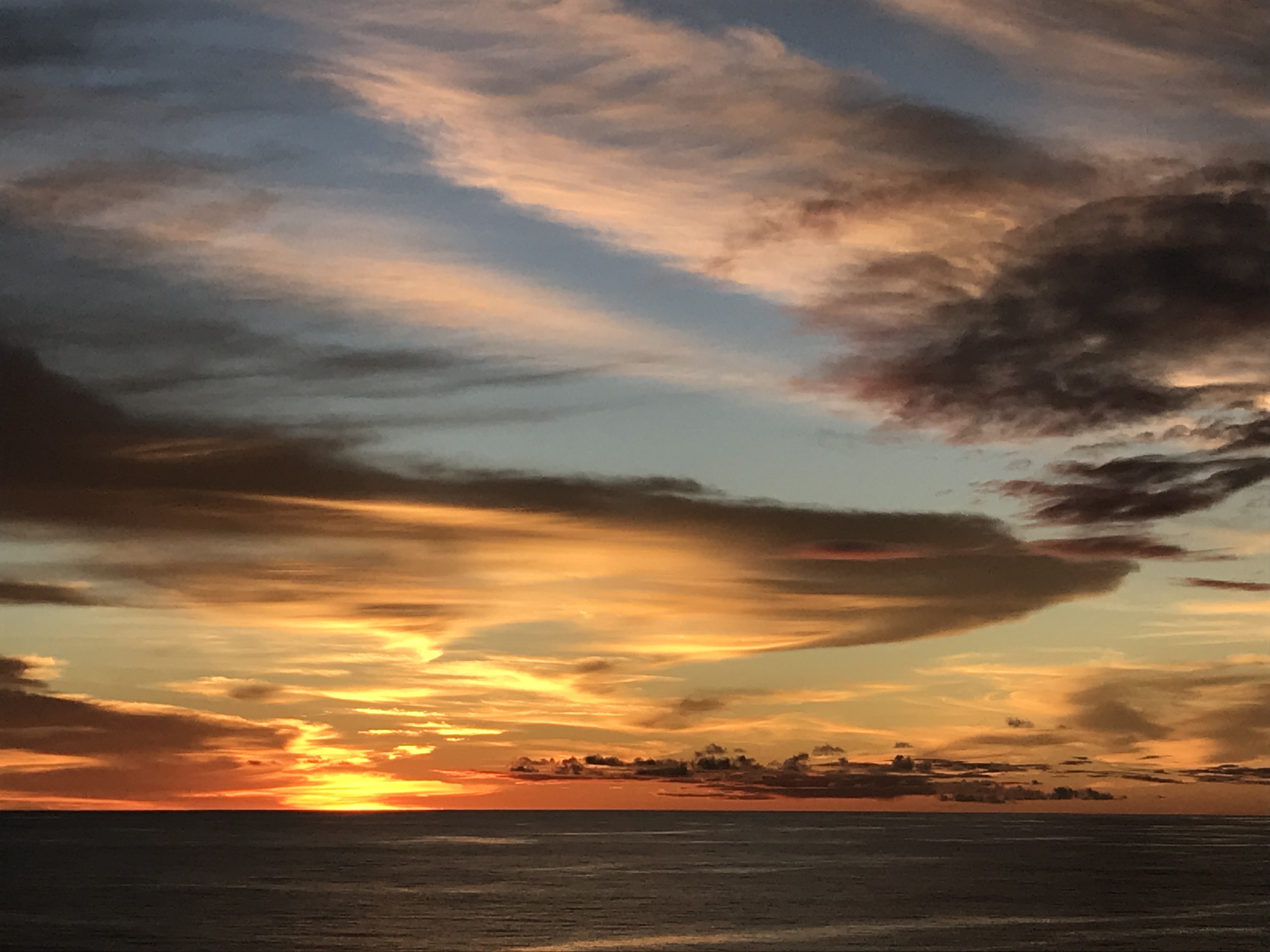
out in the early evening produced a beautiful sunset and many photos, and we’re
on our way to Bora Bora!

 C&C travel the seas