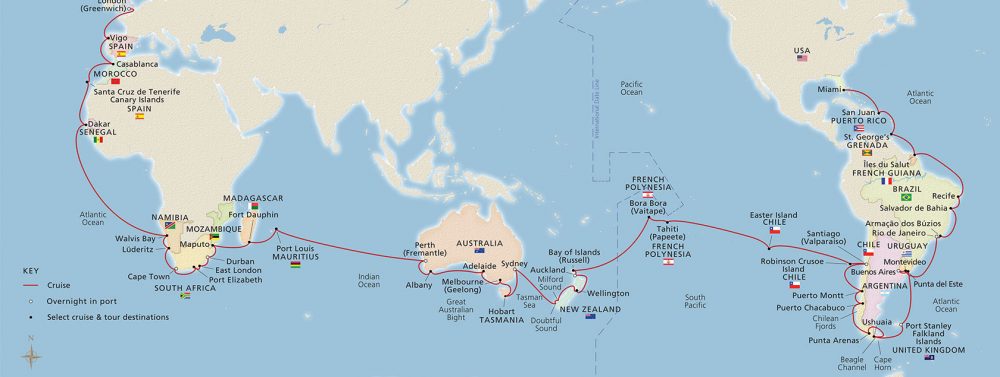
I’d say ‘rounding the Cape of Good Hope’ but it turns out the Cape of Good Hope is not the southernmost point of Africa, Cape Agulhas miles to the southeast is. Indeed, the Cape of Good Hope is not even the southernmost point of the Cape of Good Hope Peninsula; rather that is the nearby Cape Point . Nonetheless this whole area is the southern end of Africa and where the warmer Indian Ocean meets the colder Atlantic Ocean, resulting in some turbulence which we are feeling today—though I’m told it is often much worse.
We heard an excellent lecture this afternoon by Edward Lynch, Professor of Political Science at Hollins University—where former Middlebury chemistry professor Maggie O’Brien was President in the early 1990s—on the political history of South Africa since the iconic Nelson Mandela, and it was an excellent lecture. I look forward to more lectures by him.
Something Prof. Lynch said reminded me to include in this blog something one of our guides yesterday mentioned when questioned. Southern South Africa has been under great drought for the past few years—Cape Town almost ran entirely out of water a year or so ago. It is better now, Prof. Lynch said, partly because of rain farther north in Africa where the rivers begin and partly because of strict water use regulations. Our guide said many now have cisterns to collect rain water. The water she collects she uses to run her shower and washing machine; the water she retrieves from those uses is for flushing her toilet. –Cynthia
Convergence of Oceans, Atlantic and Indian. We passed Cape Horn on the way to Cape Town, raising among some a “concern” about exactly where the two oceans meet. With a modern map in hand, they definitely do not meet at the Cape of Good Hope or even at Cape Point, an extension of the continent several miles SE of the Cape. Rather, the southernmost land mass of the continent occurs at Cape Agulhas SE of the Cape of Good Hope.
All of this may seem like geographical picking of nits. But the meeting of the warm Indian Ocean with the much colder Atlantic Ocean has both ecological and hydrological significance. Extensive Atlantic cold water kelp beds extend eastwards from Cape Point and end abruptly at Cape Agulhas. Moreover, the mixing of the colder and warmer waters often produces surface turbulence, which as Cynthia has indicated the Viking Sun did not experience. –Chris
 C&C travel the seas